 If you think that market commentators in general are sounding somewhat cautious, you should try reading the farewell thoughts of Martin Taylor, a hedge fund manager who announced a little while ago that he is shutting down his hugely successful hedge fund Nevsky Capital because, in his words, he can no longer see a way to make money in today’s overblown market conditions. After generating an impressive compound return of 18.4% per annum from his fund since the year 2000, he has announced he has had enough and is retiring to spend more time with his accumulated riches.
A rather dramatic way to announce that you are bearish, you are thinking? Yes, but it is not that uncommon in the hedge fund world, where investors are notoriously quick to punish any fund which fails to deliver impressive short term results. As it happens Mr Taylor is one of the few hedge fund managers who has unquestionably earned his corn over the last 20 years, although much of the reward in early years came at a time when he was still investing primarily in more obscure Eastern Europe markets, where inefficiencies abound and the potential risks and rewards to active investors are both commensurately higher.
For the last two years his fund has made no money at all, although he did take time out, surprisingly perhaps, to pledge a lot of money to the Labour party ahead of the last general election. But don’t hold that against him. He has plenty of interesting to things to say about the way that financial markets behave has changed since the global financial crisis. Among others he mentions: the impact of high frequency trading, the reduced liquidity in many market sectors (following tighter bank regulation) and ever less reliable statistics (from governments) and earnings numbers (from companies). He too is worried about the deflationary threat that a combination of technological change, China’s slowing economy, the maturing business cycle in the United States and currency spats are creating.
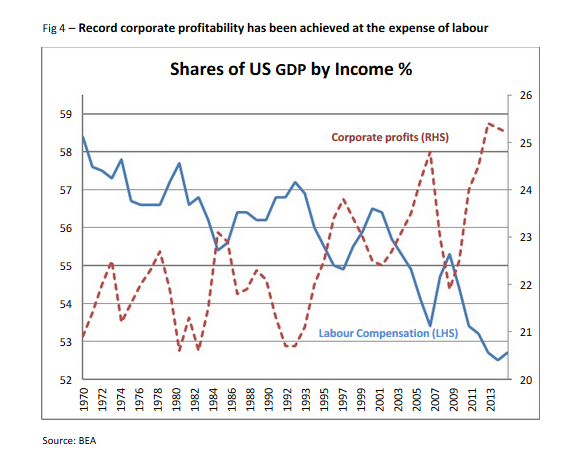
He notes for example that if the participation rate of the US employment market had not declined as fast as it has in the last few years, the unemployment rate would still be 8.7%, instead of its current ultra-low (by historical standards) 5.0%. The Fed would not be thinking about interest rate rises if the participation rate was still the same as it was in 2008. Companies meanwhile have squeezed so much out of their costs since 2008 and with revenues falling and wages starting to pick up, their record profit margins look vulnerable – being held up only by increasing usage of debt.
His conclusion is not as simple as saying that equity markets have to fall, but is a somewhat more nuanced warning that the potential outcomes have become awkwardly (or rather dangerously) binary. China and the US hold the key to what comes next. In his words:
Intriguingly though, these problems do not preclude material upside to markets from here. The balance of risks suggests markets will go down, but the current record high global savings rate, in combination with QE from the ECB and BoJ, means developed markets could yet experience the kind of late cycle liquidity bubble – again centred on tech that temporarily ‘blew the roof off’ normal valuation criteria in 1999-2000. Likewise the very stresses that China is under could result in the government there eventually choosing to eradicate the main representation of their problems – too much debt – via QE funded purchase and cancellation of NPLs from the banking sector. Were this to happen emerging market equities, which are massively under owned, would soar overnight as the quality, duration and cost of capital associated with Chinese growth would be transformed for the better.
The problem with this potential dispersion of returns – majority logic saying that there will be a grinding downside, but with a not insignificant minority risk of sudden upside driven by global liquidity or Chinese policy – is that they are inherently contradictory with regard the investment conclusions they produce. Being bearish and going net short given the risk of unforeseeable sharp upside is not a sensible option, whilst being long given the growing risk of a bear market, is equally not palatable. Taking a middle path of no net exposure but a large gross is also not obvious given the rising event risks surrounding large individual stock positions described earlier in this newsletter. There is, quite simply, no answer that squares this particular circle.
Although you may have little interest in hedge funds, Mr Taylor’s farewell letter is well worth reading in full:
His point that the market outlook is becoming more binary in a world where reckless monetary experiments have become almost routine is worth bearing in mind as this year’s events unfold. I suspect it may become a recurring theme – but one that you are unlikely to hear much about from your friendly wealth manager or adviser, should you have one. Too unsettling.
Main image source: istockphoto.com
Martin Taylor photograph source: citywire