
The brutal sell-off in equity markets around the world has continued well into its third week, making this easily the worst start to a year that anyone, including any number of dusty-haired statisticians, can remember.
Personally I have to admit to rather liking these hairy periods in markets, as they invariably create buying opportunities for those who are willing to look and have no pressing reason to sell. This is particularly true if you favour investment trusts, as I do, since you can often find discounts widening to attractive levels in times of turbulence. A good example came 18 months ago when shares in the Lindsell Train investment trust, a company that I had been looking to buy into for years, suddenly fell to a discount after years of trading at a substantial premium (which they do again today). Since I managed to get in on that happy day, the shares have comfortably outperformed everything else in the general global sector.
Are there any such tempting opportunities today? It seems that the answer is “not so many”. Partly that reflects the fact that valuations generally have been driven to high levels by years of QE and cheap money. Another reason is that more investment trusts than before now employ discount control mechanisms, which limits the scope for egregious bargains. Even so, the average discount (the dashed line in the chart below) has come in a long way as the bull market has progressed since 2009 and is now close to its highest level for a long time, a sign of the bull market’s maturity. Nevertheless, after such a dismal performance by the major indices since the start of January, it is disappointing not to find more glaringly obvious steals out there.

Source: J.P.Morgan Cazenove
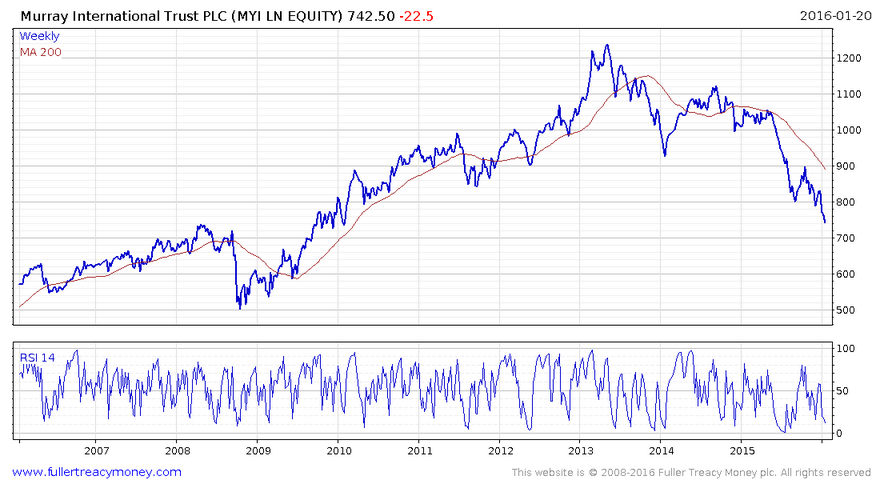
Scanning through the latest prices, some names do still stand out. Murray International, for example, managed by the canny and soft-spoken Dundonian, Bruce Stout, has been trading at a premium for so long that it has been able to issue a mountain of new shares, doubling the issued share capital over five years. It now trades at a discount for the first time in ages, thanks in part to its hefty exposure to emerging markets and the manager’s uncompromising commitment to being paid for what he owns, in the shape of securely covered dividends from globally competitive businesses. Murray International (MYI) now yields more than 6.0% and is on a discount of a trifle over 4%, a level not seen in years. It may go wider still, of course, until the emerging market story improves, but looks a good bet for the SIPP or any other long term portfolio.
For those of a more nervous disposition, looking to batten down the hatches against tougher economic times ahead, it may also be worth taking a look at Capital Gearing Trust (CGT), a specialist trust that has rarely featured on any broker’s buy list, being both very closely held and almost invariably trading at a premium. These days you can however pick up some shares at around net asset value for the first time. This is not primarily because of the performance of the trust, which has been outstanding over almost its entire three-decade history, but is the result of a conscious decision by the board last summer to introduce a discount control mechanism for the first time since a then junior Cazenove partner, Peter Spiller, took up the running of the trust more than 30 years ago.
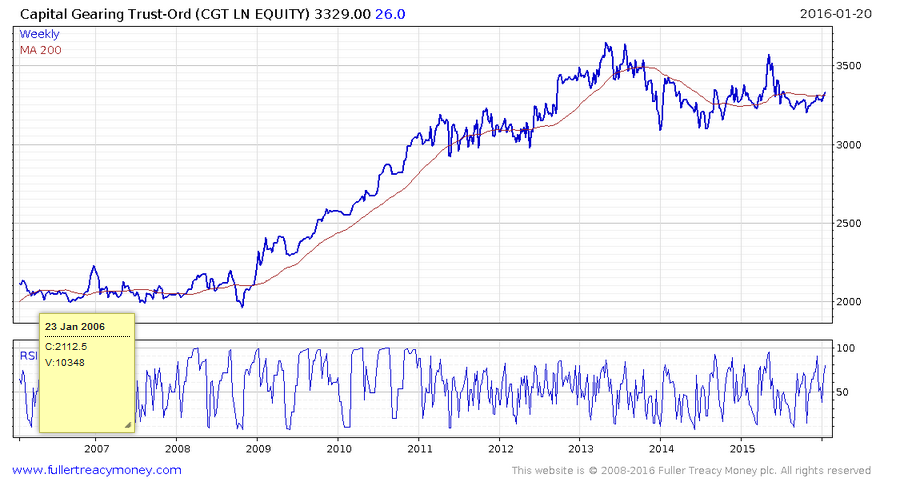
The objective of the policy, unusually, is not to so much to narrow the discount as to eliminate the premium and broaden liquidity in the stock, which has always been very narrow. Mr Spiller continues to run the fund, despite stepping down from the board last year, but at some point will no doubt be looking to realise some of his substantial investment in the trust, as will others of those who have backed him from the beginning. The shares have also not been this cheap since 2008 and being stuffed full of defensive assets (40% of the portfolio is in index-linked and cash, reflecting Mr Spiller’s gloomy global outlook and distaste for current market valuations) offer powerful portfolio ballast for anyone with an adventurous asset allocation which they are now regretting. (In the interests of disclosure, both CGT and MYI are core components of the Money Makers model investment trust portfolio, as well as among my personal holdings).
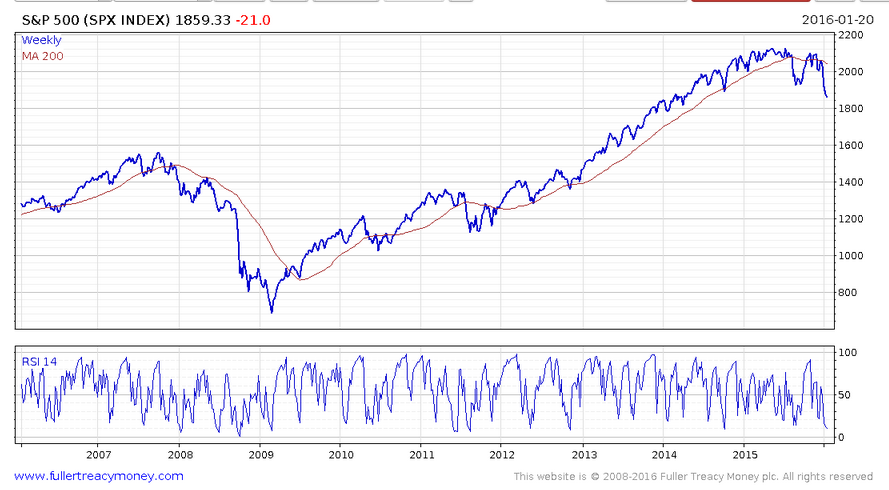
Are really on the cusp of a new bear market, to compare in scale to those of 2000-03 and 2007-09? History is clear that we would need a recession to bring that about and the evidence that one is coming is not yet compelling, although it is easy enough to make the case, as many of the investment banks have been doing. The second down-leg in oil prices is certainly a potential concern as oil below $30 a barrel brings the health of the banks that financed the shale boom firmly into the spotlight for the first time. Bad bear markets are invariably accompanied, and in some cases triggered, by problems in the debt markets. The technical behaviour of the equity markets also worries me. Short term it is clearly oversold (see the RSI below). But from a wider perspective not only has market breadth (that is the proportion of stocks that are falling as a percentage of the number that are rising) fallen quite sharply, but there have been successive “lower lows” since the market peaked at the start of last year. That is consistent with the post-2009 bull market starting to “roll over” into something worse. These are warning signs that need monitoring.
The important message for investors in times of disruption in the markets however is not to forget thinking about what they could be buying, not just what they might be tempted into selling. The worse the headlines, the better the opportunities are likely to be, and if you are too busy panicking about the sea of red on the screens, you are bound to miss the best ones, ensuring maximum future regret. As James Henderson, a fund manager whose experience goes back as far as the 1990-91 recession (which was a very nasty one), notes in our latest Q&A, unless you are feeling uncomfortable about buying something in these kind of conditions, the chances are that you aren’t making a good decision. Bargains should always feel uncomfortable at the time you are making them, just as selling good stocks before they peak should be painful too. It is what being a value investor is all about and why those who practise a value discipline so often look pinched and drawn as they go about their business.
In Henderson’s case he has been slowly and patiently starting to build new positions in Glencore, Rio-Tinto and Anglo American, the most hated and battle-scarred stocks in the upper reaches of the UK market. He is looking through the current meltdown to their future dividend-paying capacity (only Rio of the three has not announced a cut in its dividend so far). When the miners do eventually bounce, it is sure to be a sharp move. Rio-Tinto in particular is a great company that won’t be going out of business whatever happens, even if it does eventually cut its pay-out. The commodities bust is probably approaching its final capitulation phase. Buying Glencore is another matter as far as I am concerned, sitting as it does on what another veteran fund manager of my acquaintance likes to call his OMDB list – stocks that can be bought only “Over My Dead Body”. Without the career risk of straying too far from the benchmarks on which professional fund managers’ livelihod depends, private investors can afford to be choosy in this way.
Jonathan Davis