Savers are right in the firing line
The quarterly investment reviews from Jonathan Ruffer, the founder of the wealth management firm Ruffer, are always required reading, the language being as colourful as the content. The latest review, which focuses on the threat to savers from government policy, both in the UK and around the world, is no exception. He starts by noting the Chancellor’s recent moves to compromise the income of savers, with the assault on buy-to-let, higher taxes on dividend income for the wealthy and ultra-low interest rates.
Here is an extract.
The result is grim news for the saver – a sharp reduction in income, and what is left has been hit with higher tax charges. We await the last boot to fall (this attack is from Cerberus: three heads, three boots). Many investment strategies have sought out higher yield assets – and we are seeing the income from them collapse.
The big oil companies are still undecided about their dividend policies, but just before Christmas, the mining giant BHP, indicated that the dividend was being passed – what signal does this give Rio Tinto, whose outlook is similarly clouded? How about the drugs businesses, Glaxo and the like, as their blockbusting drugs go off–patent?
In the fixed interest market, the high yield sector has at last come to its senses, and is now pricing in the certainty of defaults. It is interesting to go back to the days before the cult of the equity, when nearly everyone thought only in terms of yield, and wanted the contractual comfort of a fixed interest investment, not the blue–sky possibility of a capital gain in the equity of a new business – the latter tended to be owned by the founding families.
Seen through the eyes of most of the last two hundred years, what is unfolding is something extreme; not the sort of thing that Conservative governments do when they fancy themselves radical. It is a conscious decision to compromise returns on savings – an attack, although obscured by the concomitant rise in capital values, which is the first step in the recalibration (downwards) of the savings of the country’s citizens. Let us be unsurprised when the more conventional enemy of savings – inflation – is deployed.
It is important, Ruffer goes on, to understand why a Conservative government is “pursuing a policy so little different in its effect to that of Lenin and the many socialist extremists who have followed on”. His argument is that higher inflation is the only acceptable way to head off the powerful forces of deflation. “While the Pitekkys and Lenins want to the rich to suffer, the government apply these measures for medicinal purposes – the necessary steps to rebalance the wealth from creditors to debtors, without the caesura of default”.
He ends with a bold prediction that 2016 will be the year when this policy finally breaks into the open – meaning, I think, that as the measures to confront deflation prove ever less effective, the underlying inflationary objective will become both more public and more visible to all. That in turn will, by implication, be pretty bad news for the prices of risk assets. If he is right, it bodes ill for equities in general, and small cap in particular, while in the fixed interest market “the high yield market has at last come to its senses, and is now pricing in the certainty of defaults”.
Given these views, and its absolute return objectives, it is not surprising that Ruffer’s investment strategy has been defensive for some time now –and taking a purist view of performance, too early to have been so. Ruffer portfolios are designed to offer protection against both inflation and deflation, with a hefty dose of index-linked and an above average holding in Japanese equities.
Shares in its quoted investment trust, the Ruffer Investment Company, which typically trade at a significant premium, have fallen over the course of the past 12 months – a disappointing outcome. Thanks to its success in navigating the global financial crisis in 2008, however the ten-year returns remain both positive and ahead even of the average trust in the global sector, as well as the cautious model of financial advisers (line C in the chart). If you buy Ruffer’s thesis, you won’t want to sell them now. As a holder of the shares (alongside a number of more risk-on funds), I certainly take that view.
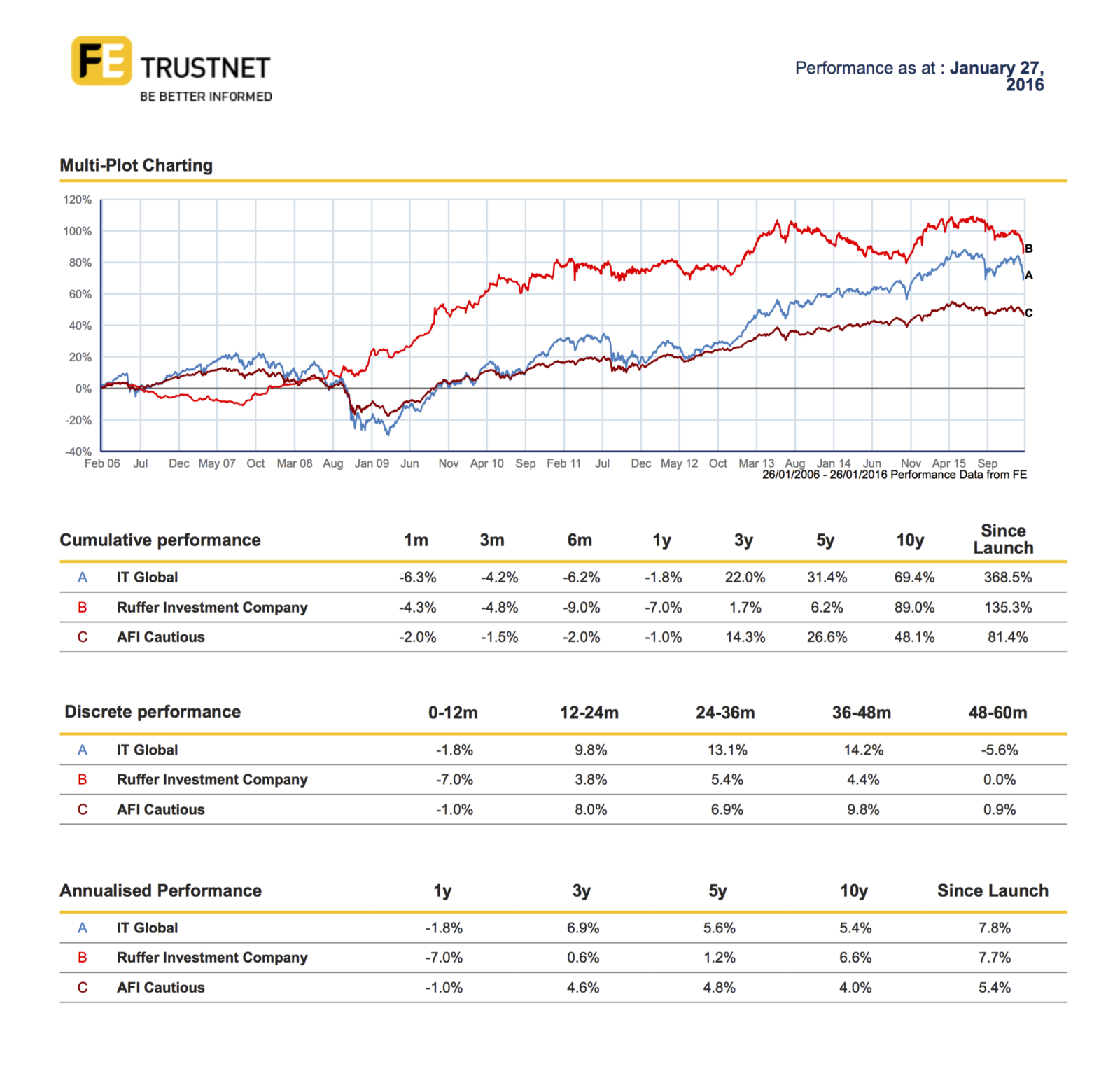
Source: FE Trustnet
Main image © http://istockphoto.com
[printfriendly]