Central bankers are losing their followers
Since the financial crisis market forecasts have consistently been wrong, almost invariably in the same direction, underestimating growth and over-estimating bond yields. But now financial conditions are tightening? Why? Because, says Gerard Minack, former Morgan Stanley pundit turned independent commentator, investors are losing faith in monetary policy and the power of central bankers to keep on pumping up asset prices. You can read his comments in full on the Woodford Funds blog. He doesn’t think that is going to change – a hugely important development for risk assets if he is right. It could mark a turning point in the post-crisis cycle.
The euro is still “extraordinarily dangerous”
Mervyn King (as was, now Lord King of Lothbury), the former Governor of the Bank of England, makes a similar point in his new book The End of Alchemy, which has been serialized in The Telegraph this week. Monetary policy alone cannot save us from another financial crisis, he says. He also highlights how “extraordinarily dangerous” the euro project has become. “Put bluntly” he concludes
“monetary union has created a conflict between a centralised elite on the one hand and the forces of democracy on the other. In the euro area, the countries in the periphery have nothing at all to offset austerity. They are simply being asked to cut total spending without any form of demand to compensate. I think that is a serious problem. I never imagined that we would ever again in an industrialised country have a depression deeper than the United States experienced in the 1930s and that’s what’s happened in Greece. It is appalling and it has happened almost as a deliberate act of policy which makes it even worse”.
When will Buffett go ex-growth?
This week has also seen the publication of Warren Buffett’s annual letter to shareholders, a regular must read for all investors. This year’s letter is shorter than usual on general observations about the craft of investing, but interesting on the reasons for long term optimism about the US economy (a familiar theme) and climate change (whether a real danger or not, “not a concern for investors”). The insurance business whose cash flow (or “float”) is the engine that has powered Berkshire Hathaway’s exceptional returns over the past 40 years gets another big write up. For an interpretation of what this means for shares in Berkshire Hathaway, you may find this (quite dense) commentary by a long term Buffett follower helpful. More interesting perhaps is his earlier post Berkshire Hathaway: The Next Ten Years, which assesses the probability that at some point not too far away the company will decide to start returning capital to shareholders in large quantities, just as Microsoft started to do about 20 years ago.
Who to blame for secular stagnation
Is “secular stagnation” a risk for the US economy, as Larry Summers, former US Treasury secretary, has argued? The historian Edward Chancellor assesses this issue in his latest column for Breaking Views. These concerns are nothing new, he notes.
“Unsurprisingly, the notion of secular stagnation was first mooted in the aftermath of the Roaring Twenties. The boom, wrote Alvin Hansen in 1934, comes about when industry is “artificially stimulated by an overdose of easy credit [which]…is the basic cause of the depression.” Hansen lamented that Americans in the early 1930s had shown a “degree of public nervousness and impatience which has necessitated wholesale experiments with forced methods of recovery.” Similar traits resurfaced in the wake of the last financial crisis. Secular stagnation is the unintended consequence of easy money policies, both before and after 2008. It’s only while those remain in place that Buffett’s breezy optimism about America’s economic future looks misplaced”.
In the eye of the storm
Jacob Rothschild (Lord Rothschild) is also worried, he tells investors in RIT Capital in its latest annual report, published this week. Here are a couple of extracts: “We became increasingly concerned about global equity markets during the last quarter of 2015, reducing our exposure to equities as the economic outlook darkened and many companies reported disappointing earnings. Meanwhile central banks’ policy makers became more pessimistic in their economic forecasts for, despite unprecedented monetary stimulus, growth remained anaemic. Not surprisingly, market conditions have deteriorated further. So much so that the wind is certainly not behind us; indeed we may well be in the eye of a storm. Our view is that 2016 is likely to turn out to be more difficult than the second half of 2015. Our policy will be towards a greater emphasis on seeking absolute returns. We will remain highly selective when considering public and private investment opportunities. Reflecting this policy, our quoted equity exposure has been reduced to 43% of net asset value with private investments at 26%”. (Note: RIT is a core holding in the Money Makers investment trust portfolio).
An investment trust think-in
J.P.Morgan Cazenove are the largest market-maker in investment trust shares and the go-to broker for institutional investors. I was at their annual investment trust conference, hosted by Christopher Smith, their investment trust analyst, ten days ago. The panel sessions on asset allocation, peer to peer lending (positive), emerging markets (to me, unconvincing, though the longer term arguments seem strong) and property (focus on income from here) were particularly interesting. Look out shortly for an interview on Money Makers with Sebastian Lyon, CEO of Troy Asset Management, and investment adviser to the Personal Assets investment trust, who was one of the speakers in the asset allocation debate.
The case for investing in junk
What about high yield bonds (otherwise known as junk bonds)? Yield spreads over government bonds have widened dramatically in the last year, and not just because of the falling oil price, which threatens to lead to widespread defaults among lenders to oil and energy companies. Does the crash in junk bond prices create an attractive entry point for portfolios? I have only just caught up with this note from Ben Inker of GMO, the US fund management group founded by one of my favourite investors, the grumpy Yorkshireman Jeremy Grantham four decades ago. Inker’s conclusion:
“At current spreads, high yield seems to be no worse than fair value and probably better than that, even if we assume (as we do) that we are entering a fourth default cycle. In today’s environment, that makes it one of the best available risk assets for investors. But the nature of the high yield market suggests it is a good candidate for overshooting fair value to the downside whenever defaults begin to rise in earnest”
GMO are building a position but (characteristically) Inker adds:
“It would be lovely to claim we will be able to time the bottom for credit precisely. We will not, and unlike with equities, even if we did know the timing perfectly, getting material exposure to the asset class quickly would be extremely difficult. This leaves us with the hunch we are probably getting in a little early, the fear that we might not get all the exposure we would like before spreads move to less attractive levels, and the sure knowledge we won’t get the bragging rights of having called the turn. In other words, it seems to be an utterly classic value investing opportunity”
How to monitor your wealth manager’s performance
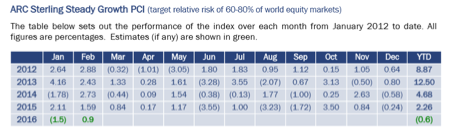
How well is your portfolio doing – or, more pertinently, how well is your adviser or wealth manager doing for you? The latest survey of wealth management performance by Asset Risk Consultants has just been released (go to www.suggestus.com for more detail). ARC lumps performance of the scores of wealth management firms whose performance they monitor into four main categories, depending on the degree of equity risk adopted. Here are the results for the steady growth bucket. As expected performance year to date has been muted – down in January, with some modest recovery in February. I will be providing regular updates on these figures as the months go by.
It is return on equity that counts, stupid
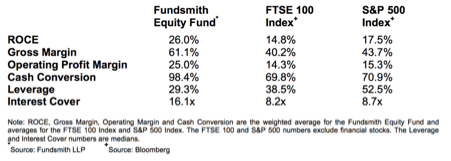
Another of my favourite fund managers, Terry Smith, was in good form at this annual shareholder meeting this week, naturally pleased (as am I) with the fund’s fifth consecutive year of outperformance and making a strong personal pitch for the merits of Brexit. It is worth revisiting his comments on the popular notion that so-called “bond proxies” – global companies that have stable earnings and strong business models – are overvalued. You can read them in the Fundsmith Equity Fund Annual letter (pdf). Note also his analysis of how the companies he owns in the fund would look if their results were reported as an ordinary listed company would do.
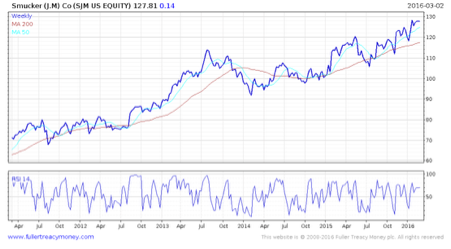
He also revealed this week the name of the two new companies in which Fundsmith has been building a position. These turn out to be IDEXX, a US veterinary diagnostics business, and the delightfully monikered J.M Smucker, another US consumer staples business. It makes peanut butter and jam, among other things. The company slogan is “With a name like Smucker’s, it has to be good”. In recent years its share price performance has been just that, but on conventional analysis the shares look expensive at 38 times earnings. It will be a good test of the Fundsmith thesis that quality always pays off in the end.