
The annual review of global investment returns produced by Professors Dimson, Marsh and Staunton for Credit Suisse is a must-read chunky publication for professional investors, providing as it does a comprehensive series of long return asset class returns and topical analysis of their past and future potential performance.
This year’s theme is the way that asset class returns vary depending on whether we are in an environment of rising or falling interest rates. With the Federal Reserve, the US central bank, raising US interest rates for the first time in seven years in December, this obviously has important implications if – and it is a big if – the Fed’s action is the first step in a process of monetary policy normalisation.
As it happens, the sharp negative market reaction to the Fed’s first tiny step last month has led to speculation that the interest rate rise could be very short-lived. With other central banks around the world easing rather than tightening their monetary policy, it is unlikely to be followed any time soon elsewhere in the world, as some had started to expect. The UK has put its rate hike plans on hold while the central banks in both Europe (predictably) and Japan (more surprisingly) have loosened policy even further since the start of the year.
Nevertheless it is well worth studying the analysis that the three academics, originally all from London Business School, report on in their latest annual review. Subscribers to Money Makers can study the findings in detail for themselves by following this link to a pdf version of the yearbook (generously provided by Prof Dimson, who is a longstanding contact of mine). Here I concentrate on a few key points.
Higher interest rates impact all asset classes
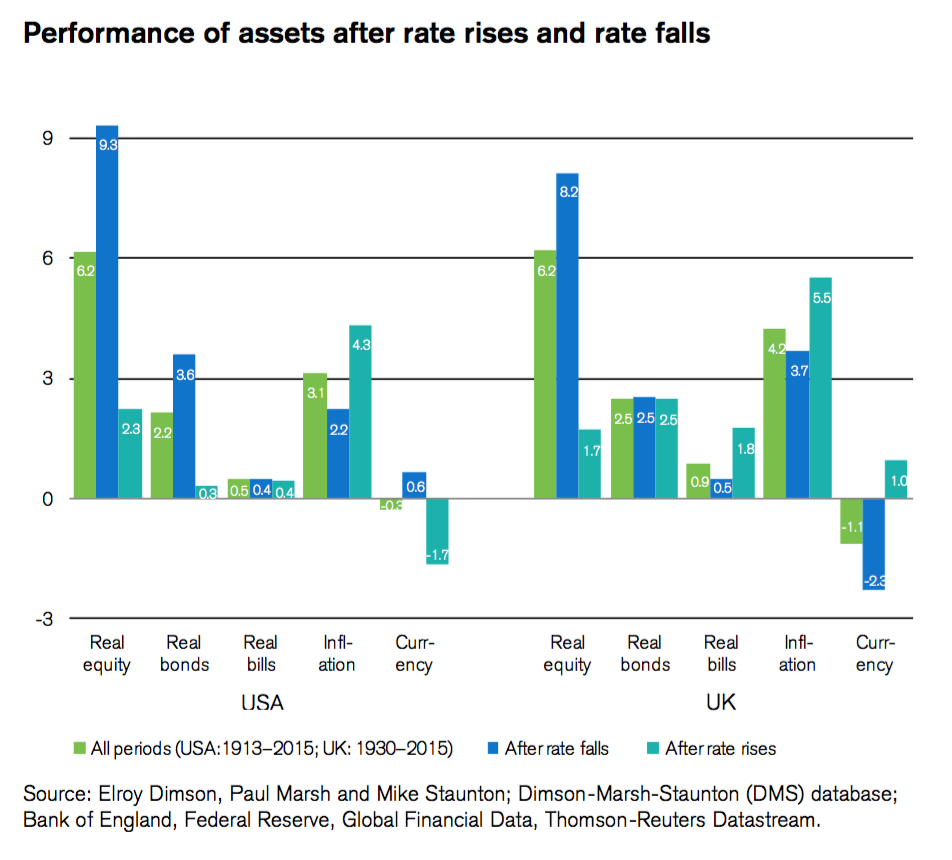
The broad assumption that most investors make is that rising interest rates are positive for equities and negative for bonds, and the historical analysis in the yearbook amply bears this out. Thus for example in the United States equities have provided a 9.3% annualised real rate of return during easing cycles, but only 2.3% during hiking phases. The results are broadly similar for the UK (8.2% and 1.7% respectively). For bonds easing periods have produced 3.3% pre annum higher real rates of return than hiking periods in the US (although, somewhat strangely, in the UK there is next to no difference on this one measure).
The chart below summarises some other key differences, with easing periods marked in blue, hiking periods in turquoise and the overall averages in green. The yearbook data on which this analysis is based goes back to the start of the twentieth century, although it is noteworthy that the effects have been similar even if you exclude the period before 1950, when monetary conditions and policies were very different. Reliable data for other countries does not go as far back as it does for the US and the UK, but the impact of interest rates is generally even more marked in other parts of the world, the professors find.
Looking more widely at some other popular asset classes, some are clearly more sensitive to interest rates than others, as the chart below illustrates. What it shows are the differences in annualised rates of returns on 11 different asset classes over two-year periods when rates are clearly rising and similar periods when they are falling. In all cases periods of falling rates produce higher returns than those when rates are rising. As you would expect gold and silver are among the most sensitive to changes in the cost of money, while farmland and other types of property are more immune.

The impact on investment styles
The academics also take a look at the effect that different phases in the interest rate cycle have on industries and investment styles. So for example they find that there is clear evidence of a “systematic relationship between the performance [of different industries] in tightening and easy cycles”. Utilities, telecoms, energy, capital equipment and healthcare companies produce good returns when rates are rising, but worse – and typically negative – ones when the reverse is the case. Retail, financial, consumer durable and listed property stocks on the other hand are affected in a diametrically different way, generally doing poorly when rates are rising and well when they are not.
Just as important for practical purposes is the evidence the professors uncover on the behaviour of investment styles. Analysing their database, Dimson, Marsh and Staunton find that the returns to a value or income style of investing do better when interest rates are falling, though still remain positive when interest rates are rising. The behaviour of small and large cap companies reverses altogether however, with the well-established phenomenon of the “small cap premium” (the tendency of smaller companies to deliver higher returns even after adjusting for risk) disappearing altogether during periods of rising interest rates.
These are all important things to bear in mind when thinking ahead with your investment strategy. The point about small cap is particularly important, given how strongly smaller companies have performed, in both relative and absolute terms, since the turn of the century. If we are in for a period of higher interest rates, the small cap dominance is likely to reverse, making it sensible to lock in some of the gains that you will have had from smaller company funds and rotating into large cap ones.
Are we at a turning point now?
The one thing that historical analysis cannot tell us, sadly, is whether sustained periods of changing future interest rates are coming or not. At the time that investors first see a cut or hike in rates, it remains unclear whether the trend will persist (as indeed is the case now). For what it is worth, the academics find that the average hiking cycle lasts just under two years and includes four rate rises, while the average easing cycle lasts just over two years with more than four rate cuts. There have been seven occasions however when a hiking cycle by the Federal Reserve consisted of just one increase in interest rates.
Will the Federal Reserve suffer the same fate this time round? There are many in the markets who think so, although my view is that we need to look beyond the initial period of turbulence before rushing to judgement. The key point for me is that studying historical analysis, as with so much of investing, enables you to use past experience to make sure you are prepared for whatever comes next. If we are about to enter a hiking cycle (which will in any event come to pass eventually, even if it does not start today), you should by then be better prepared to know what to do.
You can listen to my podcast interview with Elroy Dimson elsewhere on the Money Makers site.
Main image © http://istockphoto.com
[printfriendly]