The positive message in the charts today
Notebook; lessons of the Leave vote
Yorkshire’s finest export
Yorkshire folk did not think much of immigration, if the Brexit vote result is to be believed. That is not the view however of one of the most successful British exports of recent times, a crusty Yorkshireman who went to America but never migrated back, and to our loss has since built a hugely successful fund management business in the United States from scratch. Jeremy Grantham co-founded Grantham Mayo Otterburn back in 1977, having earlier spent a short time working for Batterymarch, an innovative investment business in Boston, Massachusetts. Grantham Mayo, or GMO for short, now looks after more than $100 billion of other people’s money (yes, $100bn, you read that right). That is not bad going for a guy who, he once told me, started his working life as a “bedpan salesman” for his father’s medical supplies business in Doncaster.
Batterymarch’s founder Dean le Baron was a colourful and visionary figure who was one of the first to try and harness computer power in the management of investors’ portfolios, as well as pioneering the case for emerging markets. Although Grantham’s own firm has not followed LeBaron down the index fund path, he remains a fearless advocate of the need to use mathematical tools when managing money. His particular hobby horse is the concept of mean reversion, the idea that while all financial markets swing from periods of boom to bust and back again, valuations – whether measured as price earnings ratios, book values or other metrics – all eventually revert to their average level over time. But he also acknowledges that this can take years to happen and that in the meantime, momentum investing – the idea that you keep on buying those sectors or styles of investment that have done well recently – will go on producing good results for longer than anyone thinks possible. In the end, though, all such momentum trades blow up. Blow up was what happened with tech stocks back in 2000 and financials in 2007, and both outcomes were ones that Grantham had warned about, albeit well before they actually happened.
In his latest must read quarterly letter, in which like all good Yorkshiremen he dispenses trenchant advice, in the manner of a Geoff Boycott or Fred Trueman, Grantham attributes both the rise of Donald Trump and the outcome of the Brexit vote to a lack of social cohesion, the growing disparity between the minority of “have a lots” and the majority of “have littles” in society. This populist backlash has been widely commented on, but Grantham characteristically has a chart to show that it has been most visible in countries where the disparity between the richest and the average citizen has become most marked. The US and the UK are high up the list that list. If that correlation holds, watch out for more political trouble next in in Greece and Portugal and (more surprisingly) Australia and New Zealand.
 As for the equity markets, he remains of the view that they are overvalued on mean reversion grounds, but they probably won’t come down to earth for a while, such is the force of the monetary measures (QE, cheap money and so on) that are being used to keep them in the stratosphere. “Despite brutal and widespread asset overpricing” he says “there are still no signs of an equity bubble about to break, indeed cash reserves and other signs of bearishness are weirdly high”. All the great market declines of modern times, he points out, when the stock market fell at least 50% – 1972, 2000, and 2007 – were preceded by “great optimism as well as high prices. We can have an ordinary bear market of 10% or 20% but a serious decline still seems unlikely in my opinion”. In other words, the message is: stay calm for now, but be prepared for trouble ahead. There is still too much gloom around to call this yet a huge market top.
A cautionary tale
A prominent hedge fund investor at one of the best known firms in London was at school with George Osborne and has been close friends with the former Chancellor ever since. Two days before the referendum he called Mr Osborne to enquire how the campaign was going. The reply he got: “We are very confident of getting a decent majority”. There was no reason to doubt his word. It would have been the easiest thing in the world for Osborne to say something less clear-cut, if that had been how the leaders of the Remain campaign saw it. As it was a private conversation with a friend of more than 30 years standing, this was not a case of “he would say that, wouldn’t he?” We know from many other sources that Osborne and Cameron were indeed highly confident of having won the vote. That confidence was shared by the financial markets and, it seemed, the bookmakers.
The moral: to be a successful investor, you need good information and good contacts. But when it comes to judging what the great British public is thinking, even the best information and the best contacts count for nothing. You might as well go down to the pub. Listen to what is being said there and you are likely to do just as well as the richest hedge fund manager. Thousands did just that, it seems. Although the weight of the money at the bookies was heavily weighted towards Remain, the number of individual bets on Brexit outnumbered those for Remain by a comfortable margin. The people not only spoke, but backed their vote with hard cash, just as hedge fund managers are supposed to do, albeit on a somewhat grander scale.
Impressive but meaningless
The analysts at FE Trustnet had the bright idea last week of looking to see which fund managers had outperformed the market both in the run-up to the referendum and in the month that followed. Needless to say there weren’t that many who managed both. Few fund managers had actively positioned their portfolios for Brexit and many have since been forced into hasty readjustments once the No vote came through. According to the Wall Street Journal, the dispersion in performance between stocks that have done well since the vote (such as utilities, drug companies and consumer staples) and those that have done poorly (such as banks, retailers, house-builders) has been the most extreme we have seen since the great financial crisis – the worst possible scenario for active fund managers.
Since most actively managed funds are also biased towards the midcap and small cap sectors, their poor performance relative to the Footsie index of larger companies makes it a racing certainty that most actively managed funds will have had one of their worst months for quite a while. (They had a decent run for a year or so before that however). Fully 14 of the 32 funds that did pass the FE Trustnet test (out of more than 230 in the UK All Companies sector) were index-tracking funds. By definition, although they can fall, tracker funds can’t underperform during a shock event, such as the Brexit result turned out to be. They also benefit from being more diversified than the average actively managed fund.
Credit therefore to Hugh Yarrow of Evenlode Income who topped the list of funds that did well both before and after the Brexit vote. He is a rising star that many fund analysts already speak highly of and this result clearly won’t do him any harm. Among the better known funds Newton Income and Jupiter Income (both under relatively recently appointed new managers, however) came out particularly well. That doesn’t alter the fact that a single month’s performance, even a dramatic one like the one we have just seen, is worse than useless when it comes to assessing whether a fund manager has genuine skill or has merely been lucky. Fund managers need to have worked through one and preferably two full market cycles (which means a career of at least ten years) before that kind of judgment can be made with anything resembling statistical confidence
Chart of the week: poor returns ahead
The investment climate promises to be difficult over the next decade, even assuming a reasonable growth backdrop. The starting point of very low real bond yields is especially problematic, but returns from equities will also be subdued by historical standards, according to our latest annual long term returns report. A structural overweight in equities versus bonds is appropriate in a moderate global growth climate. The next several years could be especially difficult for portfolio managers, assuming a gradual normalization of interest rates, as bonds could generate losses.
The key investment strategy implications of MRB’s forecasts are:
- Equity and bond returns will likely be negatively correlated in the next several years as interest rates rise. This implies that DM government bonds will provide effective diversification for periodic equity downside, but at the cost of aggregate portfolio returns.
- EM equities represent the most attractive asset class in terms of real return potential given the depressed starting point of valuations and earnings. History indicates that over time, EM real earnings will broadly correspond with underlying economic conditions, which bodes favorably for the asset class.
- China’s stock market, in particular, is poised to deliver outstanding real returns over the long run for investors willing to tolerate risk, but with a positive view on the country’s ability to navigate its economy onto a more sustainable growth trajectory.
- European equities, including the euro area, Swedish and U.K. markets, also offer comparatively strong returns. Current perceived risk factors imply prospective outperformance if earnings revert toward historical norms (based on the ROE).
- Spread products, most notably U.S. high-yield debt and EM sovereign debt should also generate solid real returns given the decent starting point and should be overweighted within a fixed-income portfolio.
The risk-reward trade-off for stocks and bonds is poor compared with past decades, based on conventional metrics. Equity and bond volatility will likely be high compared with prospective returns in the coming decade. Arguably, the trade-off for bonds will be worse, with rising yields likely to correspond with an increase in annual volatility even as returns deteriorate (or go negative). The challenge will be greater during the monetary normalization phase of the next several years, with better returns thereafter.
Peter Perkins, MRB Partners
MRB Partners is an independent strategy firm that is widely recognised as one of the most astute in the investment business. Website: www.mrbpartners.com.
Notebook: Terry Smith, what next?
Terry Smith is not lacking in self-confidence, to put it mildly, but I think even he must be agreeably surprised by quite how successful his Fundsmith global equity fund has become. I am not talking about the performance of the fund, which has been exceptional, although not a surprise, given the inherent soundness of his investment philosophy. It is the weight of the money that he has been able to attract which is the real eye-opener.
Speaking to him last week after the AGM of his other investment management venture, the Fundsmith emerging markets investment trust, it seems that the main fund took in something like £400m in new flows last month alone. The fund now has £5.8 billion in assets, all the more remarkable since the Fundsmith fund has never found its way onto the buy list of the country’s largest fund broker, Hargreaves Lansdown, whose endorsement (or lack of it) can make or break the fortunes of lesser mortals in the fund business.
 Despite this lack of support, but no doubt reflecting his talent for PR, Terry’s fund regularly occupies one of the top five spots in the list of most popular funds on the HL platform. When he launched the fund in 2011 I remember him telling me that his ambition was centred on reaching £200m in assets so that he could cover his costs.
Now with his 1% management fee, the fund management business is probably earning around £50m in fee income a year on 29 times that initial target sum. the obvious question now is: how long can the performance of the fund continue to leave all competitors in the wake?
Since launch the fund has generated a compound annual rate of return of more than 17% per annum, an impressive figure in an era of low returns. The fund has trumped both the peer group (see the Trustnet chart below) and the MSCI World benchmark by a handsome margin. Of course the style of the fund, which focuses on established cash generative businesses with strong competitive advantages and high returns on capital has proved to be tailor-made for today’s yield-hungry but risk-averse market conditions, in which so-called “bond proxies” have flourished.

Many of his competitors are waiting eagerly for those unduly favourable conditions to change, which at some point they certainly will. The fund may well underperform for a while at that point. I can’t see the fund ever doing really badly for long however. Why? Simply because the method has once crucial advantage over most mainstream global equity funds. Just as Warren Buffett does, by focusing on businesses with sustainable high returns on capital, and holding them for longish periods, his method exploits the inherent short term bias of both fund managers and investors in general.
No matter how many times this short-termism phenomenon is documented (and it is as old as the hills), it is never likely to change. A systemic bias that overweights near-term and underweights long term growth is a persistent source of market inefficiency. So while there will inevitably be poor individual years for the Fundsmith fund, long term returns are likely to remain significantly above average as long as the strategy remains unchanged and it continues to be implemented as advertised. Can we quantify that? The rule of thumb that Terry himself uses to project long term future returns is to add the yield on a stock (or portfolio) and add the sustainable growth rate in that metric, whether you use dividend yield, earnings yield or free cash flow yield (his personal favourite).
Charlie Munger, Buffett’s long-standing sidekick, pointed out years ago that over the longer term the return on any stock (or portfolio) must approximate to the long term return on capital that the business is capable of generating, with the price that you pay for it at the outset a secondary factor (and one that becomes ever less important the longer your holding period). This is not a wild surmise, simply a mathematical necessity. The secret as an investor is to be patient enough to allow those returns to materialise, given the inevitable volatility that earnings-obsessed, broker-driven traders and fund managers will generate in the quoted share price at any point in time.
The hardest part for the fund manager – more acute than ever in an era of rapid technological change – is to find the businesses that do have business models which are genuinely sustainable over long periods of time. There aren’t that many, but the challenge is something that Terry and his colleague Julian Robins, who are both experienced stock analysts, have so far shown themselves capable of meeting. The Fundsmith Equity Fund currently trades on an earnings yield of 4.2% and has a portfolio whose trailing 12-month earnings are growing at 6.6% per annum. If that rate of growth can be sustained, it implies a long term compound rate of return of between 10% and 11% per annum – handsome enough in a low inflation world, to be sure, but a good way below the 17% per annum it has generated so far. (The free cash flow yield is currently 4.8%, and implies a broadly similar outcome, assuming say a 5% growth expectation).
Conclusion: at some point the rate of return generated by the fund is likely to fall back. Because the fund has a concentrated portfolio of 27 stocks, and a high active share, the setback may well be quite sharp at one point. But that is not necessarily a good reason to sell or reduce your holdings. Funds like Fundsmith and Lindsell Train’s, which follow a similar approach, are most valuable as core portfolio components, held through thick and thin. The real wonder, given the obvious merit of the approach, is that so few other UK fund managers to date have adopted a similar strategy in managing global equity funds.
Both he and Terry Smith have demonstrated that the method worked well for many years before the onset of today’s current exceptionally favourable market conditions. The absence of effective competition so far can only be explained by the lop-sided incentives of the fund management business, which gives more weight to minimising business risk than it does to maximising investment returns. With these honourable exceptions, the global equity sector is one of the least effective of all fund sectors as a result.
What then of the emerging market investment trust, Terry Smith’s second fund venture, which has made a disappointing start to life as a quoted entity? The Fundsmith Emerging Equities Trust, to give it its full name, is much smaller than the global equity fund, having raised £193 million at launch in 2013 and and issued an additional 0.8m shares subsequently, taking advantage of the premium to asset value which it has enjoyed for much of its time on the market.
With emerging markets close to all-time lows in terms of relative performance against developed market equities, the Net Asset Value of the trust remains 5% below the issue price. The investment strategy is the same as that of the sister fund, with the difference that the component holdings have to be companies which derive the clear majority of their revenues from developing countries. Taking the same metrics as those adopted above, the portfolio has an earnings yield of just 2.7% and recorded earnings growth of 16.6%, which points to an expected long term return of around 19% if those figures are maintained (more likely perhaps is that the former may rise and the former will moderate).

In my view this outlook is subject to more uncertainty than the one for the global equity fund. Many of the holdings in the investment trust have limited free floats; several are local subsidiaries of multinational companies; liquidity is often poor and there are specific country political risks. Governance standards in some cases may not be so good. All this means that the mechanism by which the underlying performance of the businesses translates, Munger-style, into commensurate share price returns is less clear-cut and less certain than with the well-established liquid holdings in the open-ended fund. Nevertheless emerging markets as a class are undoubtedly attractively priced at the moment and the performance of the investment trust, when sentiment towards developing economies eventually starts to turn, may well turn out to be excellent too.
What if we get higher interest rates?
On 19 February I took time out to talk to Professor Elroy Dimson of the Judge Business School at Cambridge University about the latest edition of the authoritative Global Investment Returns Yearbook which he and two other prominent academics, Paul Marsh and Mike Staunton, produce at this point in the calendar each year.
You can read my summary of this year’s findings, and/or download the full report yourself, here. To listen to my podcast conversation with Professor Dimson on what changes in interest rates changes mean for equities, bonds and other asset classes, simply follow the link below. This is the first of a regular series of podcasts you can access as a Money Makers subscriber.
What if interest rates go up?
The annual review of global investment returns produced by Professors Dimson, Marsh and Staunton for Credit Suisse is a must-read chunky publication for professional investors, providing as it does a comprehensive series of long return asset class returns and topical analysis of their past and future potential performance.
This year’s theme is the way that asset class returns vary depending on whether we are in an environment of rising or falling interest rates. With the Federal Reserve, the US central bank, raising US interest rates for the first time in seven years in December, this obviously has important implications if – and it is a big if – the Fed’s action is the first step in a process of monetary policy normalisation.
As it happens, the sharp negative market reaction to the Fed’s first tiny step last month has led to speculation that the interest rate rise could be very short-lived. With other central banks around the world easing rather than tightening their monetary policy, it is unlikely to be followed any time soon elsewhere in the world, as some had started to expect. The UK has put its rate hike plans on hold while the central banks in both Europe (predictably) and Japan (more surprisingly) have loosened policy even further since the start of the year.
Nevertheless it is well worth studying the analysis that the three academics, originally all from London Business School, report on in their latest annual review. Subscribers to Money Makers can study the findings in detail for themselves by following this link to a pdf version of the yearbook (generously provided by Prof Dimson, who is a longstanding contact of mine). Here I concentrate on a few key points.
Higher interest rates impact all asset classes
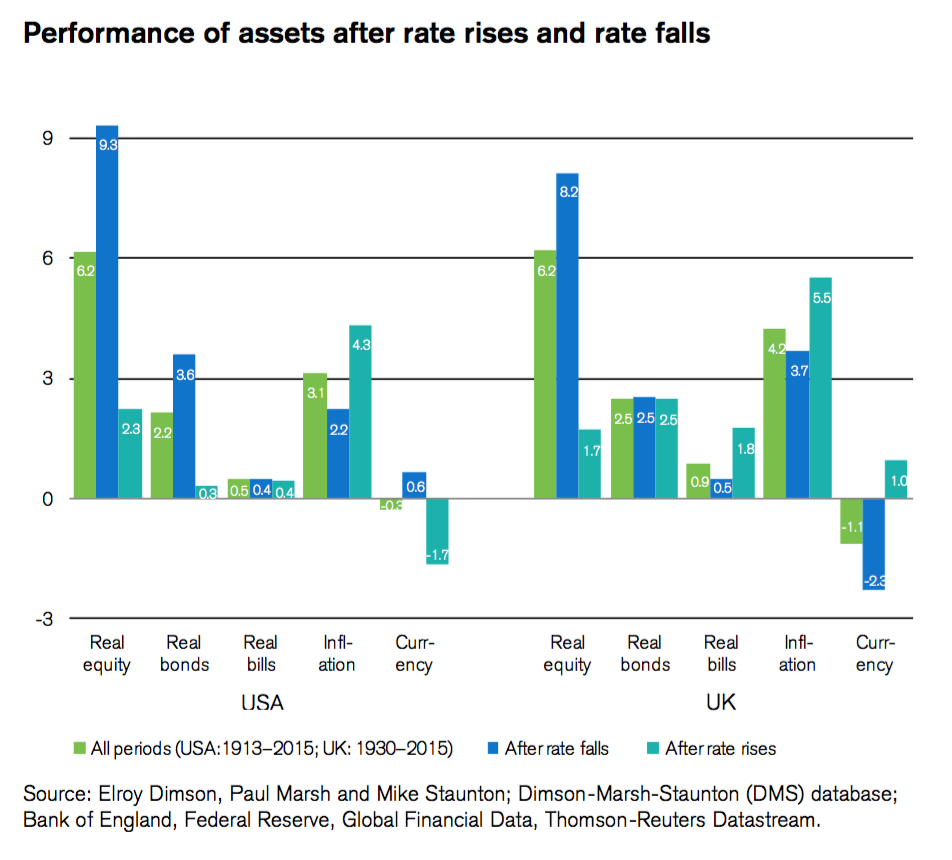
The broad assumption that most investors make is that rising interest rates are positive for equities and negative for bonds, and the historical analysis in the yearbook amply bears this out. Thus for example in the United States equities have provided a 9.3% annualised real rate of return during easing cycles, but only 2.3% during hiking phases. The results are broadly similar for the UK (8.2% and 1.7% respectively). For bonds easing periods have produced 3.3% pre annum higher real rates of return than hiking periods in the US (although, somewhat strangely, in the UK there is next to no difference on this one measure).
The chart below summarises some other key differences, with easing periods marked in blue, hiking periods in turquoise and the overall averages in green. The yearbook data on which this analysis is based goes back to the start of the twentieth century, although it is noteworthy that the effects have been similar even if you exclude the period before 1950, when monetary conditions and policies were very different. Reliable data for other countries does not go as far back as it does for the US and the UK, but the impact of interest rates is generally even more marked in other parts of the world, the professors find.
Looking more widely at some other popular asset classes, some are clearly more sensitive to interest rates than others, as the chart below illustrates. What it shows are the differences in annualised rates of returns on 11 different asset classes over two-year periods when rates are clearly rising and similar periods when they are falling. In all cases periods of falling rates produce higher returns than those when rates are rising. As you would expect gold and silver are among the most sensitive to changes in the cost of money, while farmland and other types of property are more immune.

The impact on investment styles
The academics also take a look at the effect that different phases in the interest rate cycle have on industries and investment styles. So for example they find that there is clear evidence of a “systematic relationship between the performance [of different industries] in tightening and easy cycles”. Utilities, telecoms, energy, capital equipment and healthcare companies produce good returns when rates are rising, but worse – and typically negative – ones when the reverse is the case. Retail, financial, consumer durable and listed property stocks on the other hand are affected in a diametrically different way, generally doing poorly when rates are rising and well when they are not.
Just as important for practical purposes is the evidence the professors uncover on the behaviour of investment styles. Analysing their database, Dimson, Marsh and Staunton find that the returns to a value or income style of investing do better when interest rates are falling, though still remain positive when interest rates are rising. The behaviour of small and large cap companies reverses altogether however, with the well-established phenomenon of the “small cap premium” (the tendency of smaller companies to deliver higher returns even after adjusting for risk) disappearing altogether during periods of rising interest rates.
These are all important things to bear in mind when thinking ahead with your investment strategy. The point about small cap is particularly important, given how strongly smaller companies have performed, in both relative and absolute terms, since the turn of the century. If we are in for a period of higher interest rates, the small cap dominance is likely to reverse, making it sensible to lock in some of the gains that you will have had from smaller company funds and rotating into large cap ones.
Are we at a turning point now?
The one thing that historical analysis cannot tell us, sadly, is whether sustained periods of changing future interest rates are coming or not. At the time that investors first see a cut or hike in rates, it remains unclear whether the trend will persist (as indeed is the case now). For what it is worth, the academics find that the average hiking cycle lasts just under two years and includes four rate rises, while the average easing cycle lasts just over two years with more than four rate cuts. There have been seven occasions however when a hiking cycle by the Federal Reserve consisted of just one increase in interest rates.
Will the Federal Reserve suffer the same fate this time round? There are many in the markets who think so, although my view is that we need to look beyond the initial period of turbulence before rushing to judgement. The key point for me is that studying historical analysis, as with so much of investing, enables you to use past experience to make sure you are prepared for whatever comes next. If we are about to enter a hiking cycle (which will in any event come to pass eventually, even if it does not start today), you should by then be better prepared to know what to do.
You can listen to my podcast interview with Elroy Dimson elsewhere on the Money Makers site.
Main image © http://istockphoto.com
[printfriendly]