2019: Editor’s introduction
- the bias trusts historically have towards holdings of smaller companies, which tend to outperform larger stocks
- the closed-end structure, which saves managers of investment companies from having to buy and sell stocks at inopportune moments
- the ability of trusts to buy back their shares at a discount to their real value
- to a very limited extent, the use of gearing to amplify investment returns.
2018 editor’s introduction
Over their 150 years of history investment trusts have proved themselves to be one of the great innovations in the financial world and rightly command loyalty and admiration among those who have taken the trouble to understand how and why they operate.
They remain, however, if not the best kept secret in the City, as was once said about them, still relatively little known and used by far fewer investors than they deserve to be. In an age when increasing numbers of individuals have shown themselves able and willing to take more responsibility for their own investment decisions, and the internet makes researching and monitoring investments greatly easier than in the past, anything that can shed a brighter light on the potential of the investment trust business is, I trust, to be welcomed.
The Investment Trusts Handbook you are looking at now is the first edition of a new publication. The idea behind the Handbook is to combine a detailed data-driven snapshot of the sector as it is today with a range of features, analysis and useful information that illuminates the opportunities trusts create for new and experienced investors alike. It is a reference work to keep and consult throughout the coming 12 months. The next edition will be published in November 2018.
As a longstanding investor in trusts, as well as a non-executive director, I am conscious that boards of directors need to keep pressing for improvement – keeping costs down, performance under review and portfolio managers on their toes. A flourishing trust sector is a force for good and it is important that more investors are kept aware of its potential to provide – as, in the right hands, a great number of trusts already do – a rewarding investment experience. We hope that this Handbook will contribute to that process.
Of course, some readers may say, what is the point of producing an annual handbook when so much information can be readily found in real-time on the internet? It is a fair question, but I don’t think it is that hard to answer. One reason is that while basic information about investment trusts is indeed widely available on a range of websites, and many accessible for free, the context and analytical approach you need to take full advantage of that information is not. Interpretation of data is just as important as content.
A second reason is that some of the best research on investment trusts has long come from broker analysts, but it is becoming ever more difficult for individual investors to access; indeed, from 1 January 2018, thanks to a complex piece of European legislation known as MiFID II, it will become even harder than before. With the best analysts having already effectively been prevented from distributing research directly to anybody other than professional clients, the new legislation requires that all broker research be paid for directly for by those who use it.
One consequence of these new arrangements, almost certainly, is that the number of analysts following investment trusts in the City, and with it the amount of published research, will contract. At the last count there were 14 broking firms working in the sector, and not enough fee-paying business in the coming environment to justify the cost of the research that they collectively produce. As the number covering trusts declines, it creates a gap that other publishers and research providers such as ours will seek to fill.
A third reason is that not everyone wants to spend their time using the web to do research – in my experience, even as a professional investor, it can be tedious and time-consuming to collect all the relevant information you want in one place, even when you know where to go to find it. Not every website is able to provide all the information you need – numbers, charts, links – in the form that you want it.
One particular thing that I know would help me is a convenient calendar that gives me notice well in advance of when the investment trusts that I follow are likely to produce their interim and annual results. I also appreciate having advance warning of when annual general meetings are coming up. A calendar of just that sort is one of the features you will find in this Handbook, along with a directory of all the largest trusts currently listed in the London market.
Another important function that handbooks can play is to provide understanding and perspective. There was a time when cricket fans simply had to buy Wisden if they wanted to study and compare scorecards and averages across a whole season. Today online cricket databases, like those for many other sports, are wondrous things full of arcane facts and the most extraordinary minutiae.
The scores and averages, however, were never the sole, or even the primary reason, to rush out and buy the latest Wisden, as many used to do. It also included some excellent features by and about the best cricket writers and players. The handbook format similarly lends itself to picking and reproducing interesting commentary on the investment trust sector.
This inaugural edition includes contributions from some of the most highly-experienced and well-qualified investment trust professionals around, including Peter Spiller, Robin Angus, John Baron and James Burns. Mark Dampier, the head of research at the UK’s largest retail broking firm, Hargreaves Lansdown (which is doing an increasing amount of business in investment trusts), also chips in with his observations about the sector. We also have three in-depth interviews with prominent fund managers from different sectors, some additional insights on venture capital trusts, and a section that offers broad guidance on how to analyse trusts. We are looking forward to coming up with more features for next year’s edition. All suggestions for improvements will be gratefully received. The problem, I suspect, will be to decide what to leave out as much as it is what to include.
How stands the investment trust business as we head into 2018?
At the time of writing these notes the short answer, I would say, is: in a pretty good place. Global equity markets are buoyant, which always helps, interest rates are still very low and the bond market has yet to reverse course decisively enough for us to be able to call the final turning point in the 35-year-old cycle of falling bond yields.
As a result of these positive market tailwinds and the broader use of discount controls by trust boards, the average discount across the sector – always a good indicator of its health – continues to narrow. At the end of the third quarter of 2017, the average discount on mainstream trusts was around its lowest level since the great financial crisis, while the average alternative asset trust, the fastest growing part of the IT universe, was trading at a premium to net asset value.
The emergence of a flourishing sector of alternative asset trusts, a broad grouping that extends from private equity to renewable energy, and from warehouses to mortgages and aircraft leasing, has been the most striking feature of the last few years in trust-land. The common feature that binds most of these disparate types of trust together – private equity being the major exception – is their ability to generate income for shareholders.
This in turn has spawned a steady stream of new trusts coming to the market and finding ready buyers, particularly among the wealth management and financial advisor communities, which are now the largest institutional buyers of investment trusts. Although it is not strictly true, it feels as if almost any new entity that can offer a headline yield of more than 5% will find a buyer, so great is the demand for anything with an income attached.
Trusts with what can broadly be described as an alternative asset mandate now account for around a third of the trusts in the Association of Investment Companies classification. Headline yields are not always what they appear to be, however. Trusts have a range of ways to enhance or pad out their income-generating capacity, now including the ability to draw on capital as well as revenue reserves, and you would do well to heed the advice from our contributors that it pays to look very carefully under the bonnet at how real and sustainable those yields may be.
How long the fashion for income and the persistence of premiums for these newcomers continues is one of the things that observers will be watching closely as we move into 2018. The greater diversity that you can now find in the trust universe as it has evolved today is, however, undoubtedly a source of strength. The ability of the investment trust sector to regenerate itself at periodic intervals has always been one of its defining characteristics.
History tells us, of course, that it is exactly at times like this, when all seems set fair, that a crisis may be just around the corner. The only predictable thing about stock markets, as J. P. Morgan observed many years ago, is that they will fluctuate. The cycle of boom and bust will persist as long as markets exist. Financial markets generally, however, are notable at the moment for their placidity. Volatility is at its lowest level for many years.
Experienced investors have noticed this and the prudent ones are making preparations for at least a temporary interruption in this benign picture – not because they necessarily can see the causes of the next downturn, merely that they know one will come eventually, as it always has done. Anyone who doubts as much would be well advised to study the history of the first and oldest investment trust of them all, Foreign & Colonial (F&C), which in 2018 marks the 150th anniversary of its formation.
As historian John Newlands reminds us in his essay on the subject, F&C was set up by three enterprising Victorian professionals to offer those with means the opportunity to invest in a well-diversified portfolio of high-yield bonds issued by what were then the emerging markets of their day. (A good quiz question, the answer to which you can find in John’s piece, is to ask which government amongst the 19 original issuers in its initial portfolio was the first to default?)
While F&C was the pioneer in creating a listed investment vehicle of this kind, and rightly deserves the celebrations which are to be held to commemorate the fact over the course of 2018, it has had to endure many turbulent moments in its history since. So too has the whole investment trust sector, which over the years been buffeted by two world wars and market collapses, as well as occasional scandals.
F&C owes its continued survival and prosperity in part to its willingness to take big contrarian bets at times of market weakness, as it did in 1974 and 1987. An opportunity to do so again will undoubtedly emerge in due course. Whatever the trigger, the next bear market is sure to test the resolve of existing shareholders, but it will also – just as certainly – provide an opportunity for savvy trust connoisseurs to pick up bargains as discounts widen once more. For the forearmed investor, a crisis is an opportunity, not just a threat.
In the 1930s, just as investment trusts were starting to recover from the trauma of the 1929 market crash, a new and potent competitor to the investment trust appeared in the shape of the first open-ended fund. The unit trust, as it was known, being easier to run and market, and with the huge advantage of being able to offer sales incentives to financial advisors, has continued to outsell its older closed-end counterpart more or less ever since. The investment trust has survived that threat only by its ability – admittedly sometimes only under duress – to generate superior performance and higher standards of governance.
Scroll forward 80 years and it is possible to see new – and not dissimilar – threats emerging in the competitive landscape. One is the relentless rise of passive investment, which has seen ultra-cheap index funds and more recently exchange-traded funds (ETFs) challenge the traditional dominance of actively managed funds, into which category effectively all investment trusts fall. Tracker funds and ETFs offer a direct challenge to two of the investment trust’s fundamental competitive advantages – low running costs and a commitment to effective active management.
The second threat comes from the ever-increasing burden of compliance with regulation. Ironically the Financial Conduct Authority, the financial services regulator, shows little sign of either understanding or caring much about investment trusts – in its recent Asset Management Review, it only mentioned the trust sector once by name (and that was in a footnote on p.94!). Some of the regulator’s policies, such as the banning of sales commission to financial advisors for recommending funds and the drive for greater transparency on fees, have been positive for investors. Nevertheless, the overall impact of a heavier-handed and more intrusive regime is clearly bearing down in a number of ways on the ability of the investment trust sector to operate profitably and grow.
Aside from the loss of competitive advantage of lower costs, one particularly important side effect of the new regulatory regime is that it has led to considerable consolidation in firms that traditionally have managed private client portfolios and remain the trust sector’s biggest source of institutional support. That in turn has made it much harder for new trusts in the conventional equity fund mould to come to the market. Some private client firms now say they will only support the launch of a new trust if it is capable and likely of reaching at least £200m in assets.
Unless you are a particularly highly regarded star fund manager, such as Neil Woodford or Terry Smith, that is a disincentive and a tough hurdle for firms contemplating a trust launch to overcome. Only trusts with a clearly differentiated active management strategy and investment team are able to make it to the IPO stage. Were it not for the popularity of the all-conquering high-yielding newcomers in the alternative asset space, and the resilience and longevity of the bull market, you might perhaps be hearing questions raised about investment trusts’ continuing relevance and survival.
Such questions are nothing new. Investment trusts have regularly had to demonstrate the ability to adapt or shrink and will doubtless do so again. It helps that the quality of board director, it seems to be widely accepted, has improved, as has their willingness to take a more active role in obtaining terms from their investment managers. The last couple of years have seen more trusts negotiating lower annual management charges and/or reviewing – and often eliminating altogether – the use of performance fees.
Trusts such as Scottish Mortgage have shown it is possible to use economies of scale to bring down their fees without apparent difficulty; its ongoing charge ratio of 44 basis points (0.44% per annum) for an actively managed global equity fund is certainly competitive with the cheapest index fund alternative. The most successful trusts remain profitable for fund management firms, so I suspect there is room for margins to be squeezed further. For many smaller trusts, however, given the cost of their legal and reporting requirements as listed companies, and the competitive and regulatory challenges now emerging, it is going to remain an uphill struggle to keep costs down and some will probably fall by the wayside.
A somewhat different challenge faces those whose job is to analyse and value trusts. Putting a value on a trust that invests in renewable energy, or in infrastructure projects, or peer-to-peer lending, requires a different set of skills and techniques. Trusts in a new specialist sector such as renewable energy all use different discount rates and inflation assumptions, making valid comparisons more difficult. When index-linked gilts first appeared in the 1980s, it took a few years for the market to work out how to price them correctly. Something similar may be happening now in these new sectors. Analysts too, therefore, are also having to raise their game.
Such issues aside, investment trusts are in good order. They remain the investment vehicle of choice for many of the smartest investors I know. Performance of the best ones has been good and their traditional strengths – high-quality active management, effective use of gearing, the ability to follow a conviction approach – continue to stand them in good stead. They offer investors plenty of choice and diversification potential. That is why we look forward to continuing the task of chronicling their progress in the interesting times that undoubtedly lie ahead.
Jonathan Davis
Oxford, 2017
JONATHAN DAVIS MA, MSc, MCSI is one of the UK’s leading stock market authors and commentators. A qualified professional investor and member of the Chartered Institute for Securities and Investment, he is a senior advisor to Sanderson House and a non-executive director of the Jupiter UK Growth Trust. His books include Money Makers, Investing With Anthony Bolton and Templeton’s Way With Money. After writing columns for The Independent and Financial Times for many years, he now contributes regularly to The Spectator and records a weekly interview with leading professional investors for the Money Makers podcast channel.
www.independent-investor.com
www.money-makers.co
Notebook; lessons of the Leave vote
Yorkshire’s finest export
Yorkshire folk did not think much of immigration, if the Brexit vote result is to be believed. That is not the view however of one of the most successful British exports of recent times, a crusty Yorkshireman who went to America but never migrated back, and to our loss has since built a hugely successful fund management business in the United States from scratch. Jeremy Grantham co-founded Grantham Mayo Otterburn back in 1977, having earlier spent a short time working for Batterymarch, an innovative investment business in Boston, Massachusetts. Grantham Mayo, or GMO for short, now looks after more than $100 billion of other people’s money (yes, $100bn, you read that right). That is not bad going for a guy who, he once told me, started his working life as a “bedpan salesman” for his father’s medical supplies business in Doncaster.
Batterymarch’s founder Dean le Baron was a colourful and visionary figure who was one of the first to try and harness computer power in the management of investors’ portfolios, as well as pioneering the case for emerging markets. Although Grantham’s own firm has not followed LeBaron down the index fund path, he remains a fearless advocate of the need to use mathematical tools when managing money. His particular hobby horse is the concept of mean reversion, the idea that while all financial markets swing from periods of boom to bust and back again, valuations – whether measured as price earnings ratios, book values or other metrics – all eventually revert to their average level over time. But he also acknowledges that this can take years to happen and that in the meantime, momentum investing – the idea that you keep on buying those sectors or styles of investment that have done well recently – will go on producing good results for longer than anyone thinks possible. In the end, though, all such momentum trades blow up. Blow up was what happened with tech stocks back in 2000 and financials in 2007, and both outcomes were ones that Grantham had warned about, albeit well before they actually happened.
In his latest must read quarterly letter, in which like all good Yorkshiremen he dispenses trenchant advice, in the manner of a Geoff Boycott or Fred Trueman, Grantham attributes both the rise of Donald Trump and the outcome of the Brexit vote to a lack of social cohesion, the growing disparity between the minority of “have a lots” and the majority of “have littles” in society. This populist backlash has been widely commented on, but Grantham characteristically has a chart to show that it has been most visible in countries where the disparity between the richest and the average citizen has become most marked. The US and the UK are high up the list that list. If that correlation holds, watch out for more political trouble next in in Greece and Portugal and (more surprisingly) Australia and New Zealand.
 As for the equity markets, he remains of the view that they are overvalued on mean reversion grounds, but they probably won’t come down to earth for a while, such is the force of the monetary measures (QE, cheap money and so on) that are being used to keep them in the stratosphere. “Despite brutal and widespread asset overpricing” he says “there are still no signs of an equity bubble about to break, indeed cash reserves and other signs of bearishness are weirdly high”. All the great market declines of modern times, he points out, when the stock market fell at least 50% – 1972, 2000, and 2007 – were preceded by “great optimism as well as high prices. We can have an ordinary bear market of 10% or 20% but a serious decline still seems unlikely in my opinion”. In other words, the message is: stay calm for now, but be prepared for trouble ahead. There is still too much gloom around to call this yet a huge market top.
A cautionary tale
A prominent hedge fund investor at one of the best known firms in London was at school with George Osborne and has been close friends with the former Chancellor ever since. Two days before the referendum he called Mr Osborne to enquire how the campaign was going. The reply he got: “We are very confident of getting a decent majority”. There was no reason to doubt his word. It would have been the easiest thing in the world for Osborne to say something less clear-cut, if that had been how the leaders of the Remain campaign saw it. As it was a private conversation with a friend of more than 30 years standing, this was not a case of “he would say that, wouldn’t he?” We know from many other sources that Osborne and Cameron were indeed highly confident of having won the vote. That confidence was shared by the financial markets and, it seemed, the bookmakers.
The moral: to be a successful investor, you need good information and good contacts. But when it comes to judging what the great British public is thinking, even the best information and the best contacts count for nothing. You might as well go down to the pub. Listen to what is being said there and you are likely to do just as well as the richest hedge fund manager. Thousands did just that, it seems. Although the weight of the money at the bookies was heavily weighted towards Remain, the number of individual bets on Brexit outnumbered those for Remain by a comfortable margin. The people not only spoke, but backed their vote with hard cash, just as hedge fund managers are supposed to do, albeit on a somewhat grander scale.
Impressive but meaningless
The analysts at FE Trustnet had the bright idea last week of looking to see which fund managers had outperformed the market both in the run-up to the referendum and in the month that followed. Needless to say there weren’t that many who managed both. Few fund managers had actively positioned their portfolios for Brexit and many have since been forced into hasty readjustments once the No vote came through. According to the Wall Street Journal, the dispersion in performance between stocks that have done well since the vote (such as utilities, drug companies and consumer staples) and those that have done poorly (such as banks, retailers, house-builders) has been the most extreme we have seen since the great financial crisis – the worst possible scenario for active fund managers.
Since most actively managed funds are also biased towards the midcap and small cap sectors, their poor performance relative to the Footsie index of larger companies makes it a racing certainty that most actively managed funds will have had one of their worst months for quite a while. (They had a decent run for a year or so before that however). Fully 14 of the 32 funds that did pass the FE Trustnet test (out of more than 230 in the UK All Companies sector) were index-tracking funds. By definition, although they can fall, tracker funds can’t underperform during a shock event, such as the Brexit result turned out to be. They also benefit from being more diversified than the average actively managed fund.
Credit therefore to Hugh Yarrow of Evenlode Income who topped the list of funds that did well both before and after the Brexit vote. He is a rising star that many fund analysts already speak highly of and this result clearly won’t do him any harm. Among the better known funds Newton Income and Jupiter Income (both under relatively recently appointed new managers, however) came out particularly well. That doesn’t alter the fact that a single month’s performance, even a dramatic one like the one we have just seen, is worse than useless when it comes to assessing whether a fund manager has genuine skill or has merely been lucky. Fund managers need to have worked through one and preferably two full market cycles (which means a career of at least ten years) before that kind of judgment can be made with anything resembling statistical confidence
Notebook: taking stock post Brexit
This is one of my regular round ups on the state of the markets, this time following the Brexit vote, but keeping an eye primarily on the medium to longer term context. It is easy to get sidetracked by the excitement of a new event into losing sight of the important longer term trends. Get the right side of the longer term trends and you can survive any number of short term shocks and setbacks. There is also some value in looking to spot opportunities created by excessive moves.
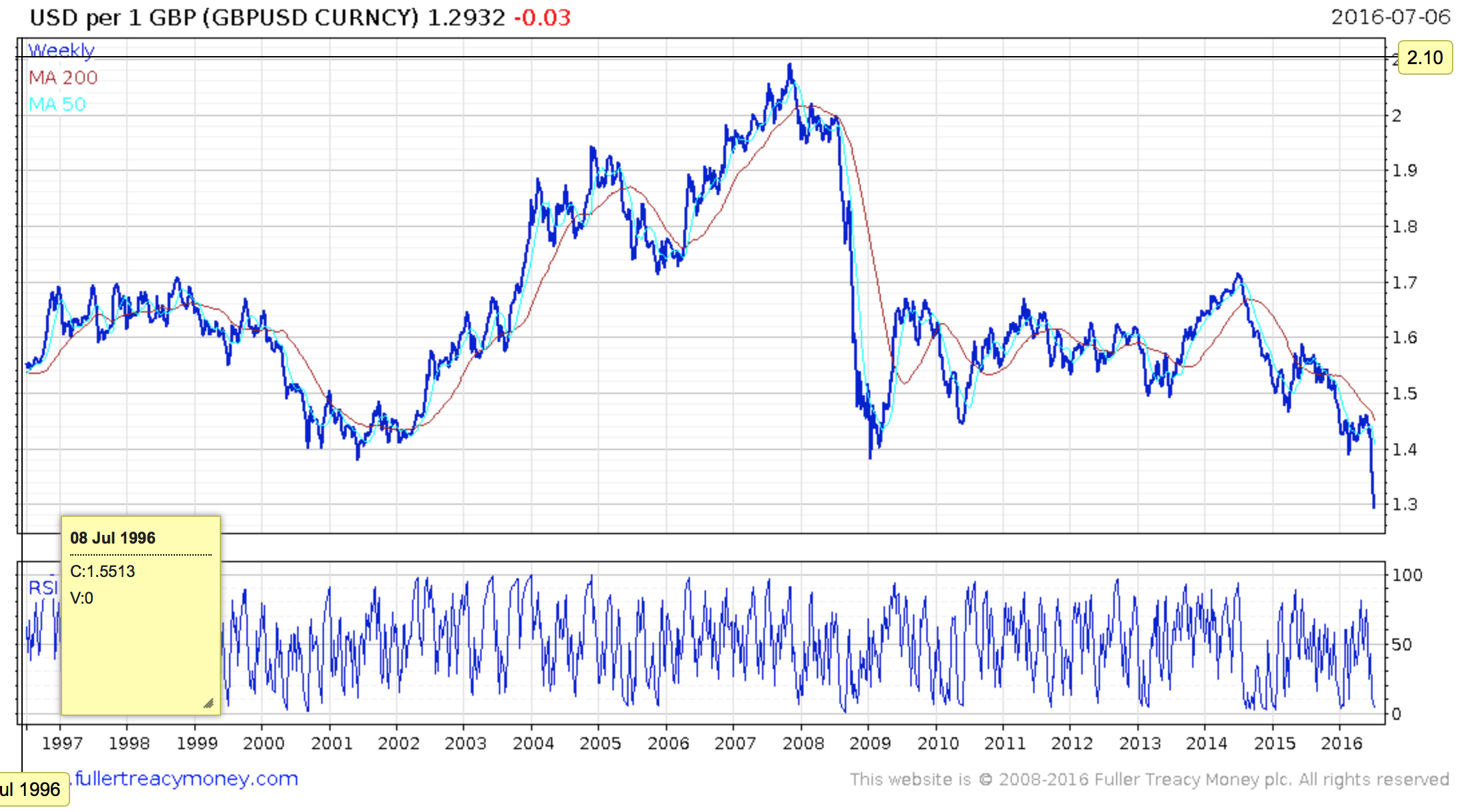
The charts are from Fuller Treacy Money and reproduced with thanks. They are correct as at midday on 7th July 2016. The lighter line on the main panel in each chart represents the 200-day moving average. The RSI at the bottom of each panel represents a standard 14 day momentum measure (overbought above 70, oversold below 30, in broad terms). Further notes will look at some of the more dramatic individual stock and sector moves and the behaviour of some model portfolios.
Sterling‘s decline has been the most obvious impact of the Brexit vote. Against the dollar, it has fallen to its lowest level since the 1980s, at the height of the miners’ strike. It is down 40% since its pre-crisis peak in 2007. Short term it now looks oversold, but it is impossible to rule out further declines, at least until there is some clarity on how and when negotiations for Brexit are likely to begin. But note that sterling has been in decline for more than two years, long before Brexit.
Bond yields have fallen together right along the yield curve. I show here both the 10-year and the 30-year yields on conventional gilts. Both are trading at all-time lows, though also appearing oversold on a short term basis. The yield curve remains upward sloping for now. An inverted yield curve, when longer term yields are lower than short term one, is a traditional warning of impending recession, but we are yet to see that materialise.
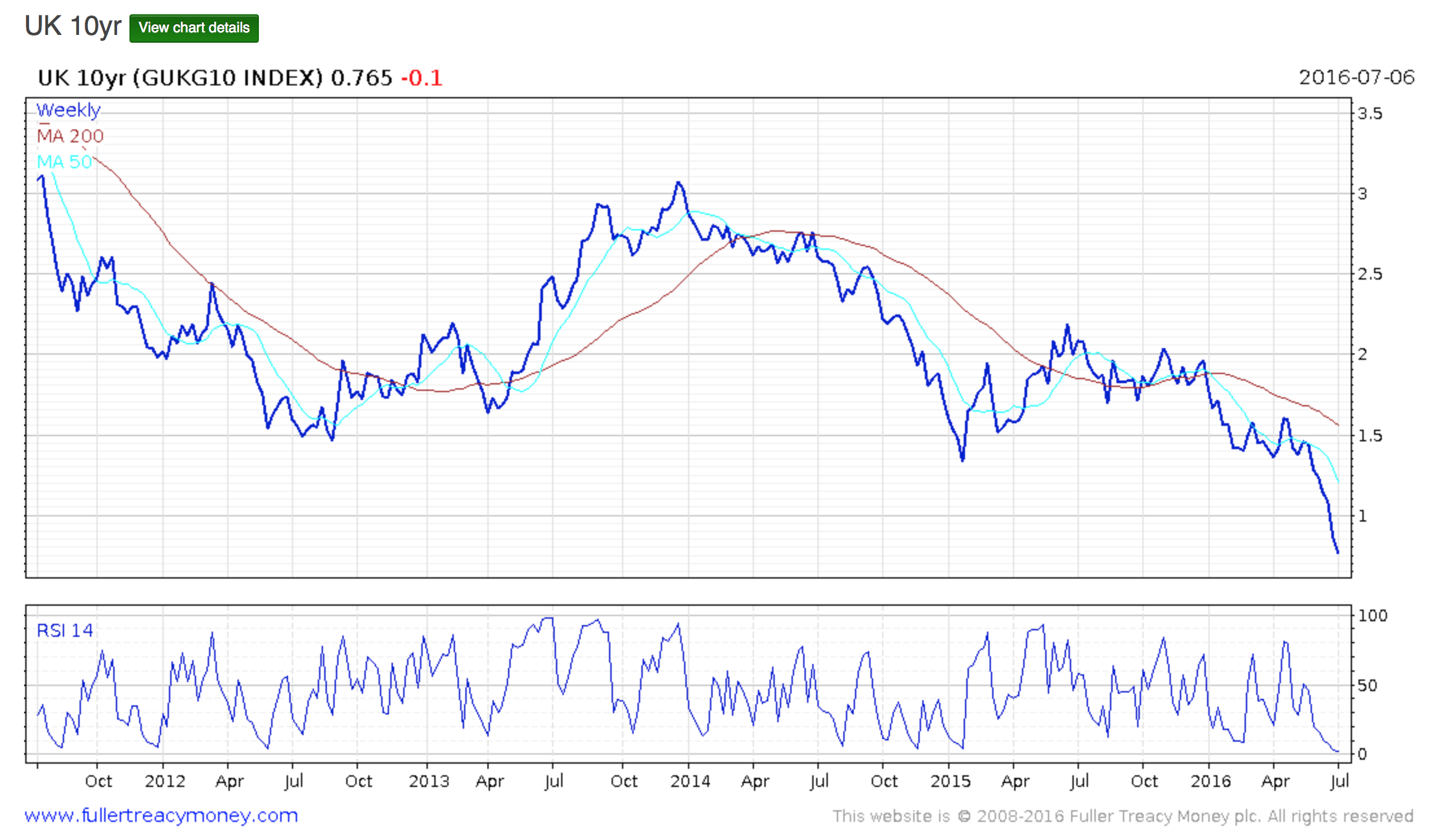
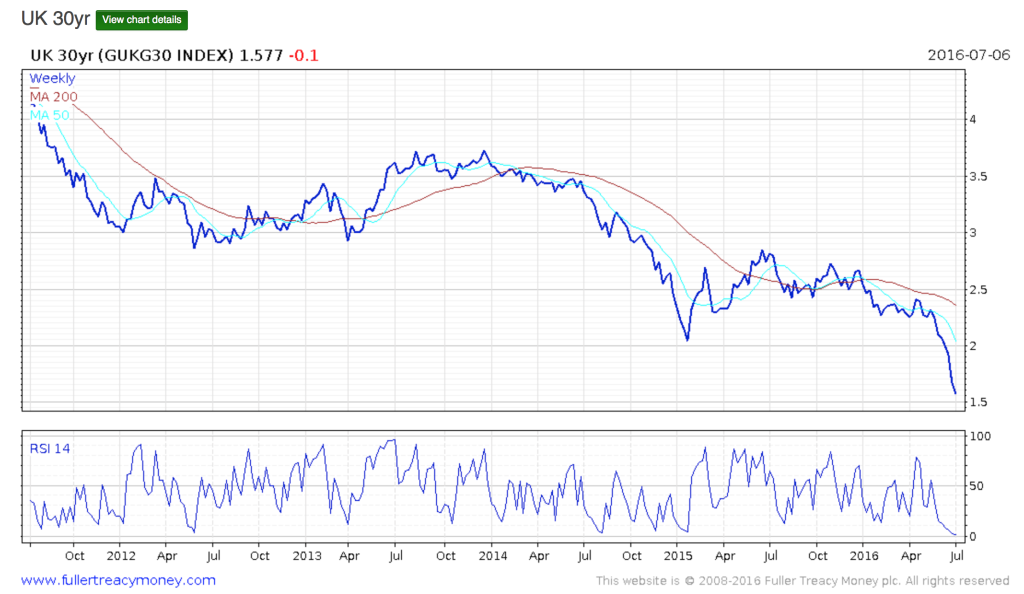
The fall in yields has produced some remarkable increases in gilt prices, particularly at the longer end of the curve (which is inherent in the structure of the market when yields are already ultra-low). It is important to remember that yields have been falling all round the world, with at least three countries (the latest being Switzerland) now able to sell 50-year bonds at negative interest rates – an unheard of phenomenon. There is no better indication of the fact that the world is trapped for now in a low growth, low interest rate, deflationary environment.

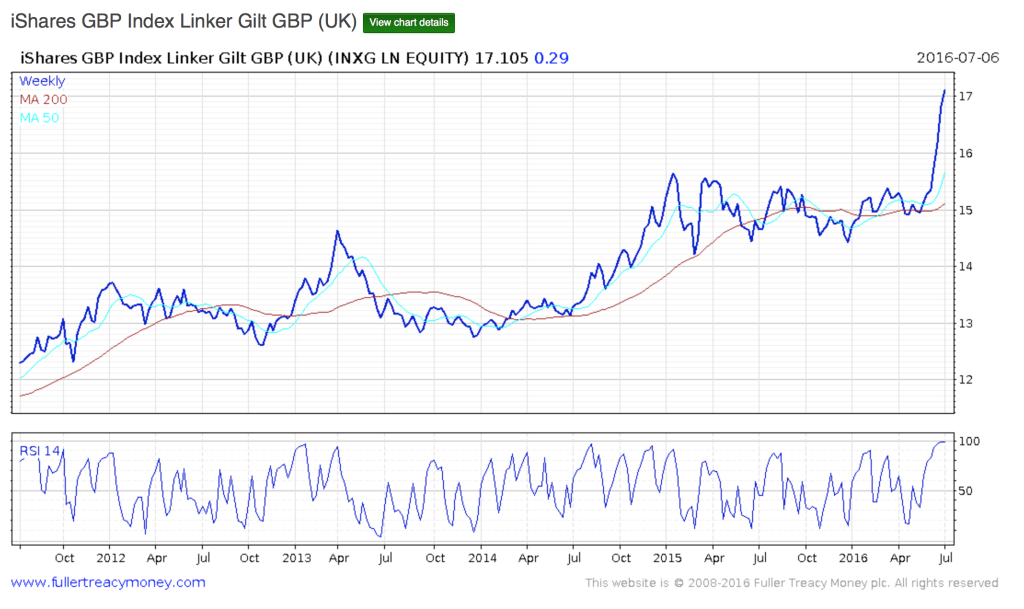
It is not just conventional index-linked gilts that have done well. Index-linked bonds, a core component in the Money Makers model portfolios, have also performed well. With inflation still at very low levels, real (inflation-adjusted) yields have also declined – another global phenomenon. That in turn has helped the price of gold, which normally does well when real yields are falling and is also benefiting from its traditional safe haven status. As geared plays on the price of precious metals, mining shares have more than doubled from their lows.

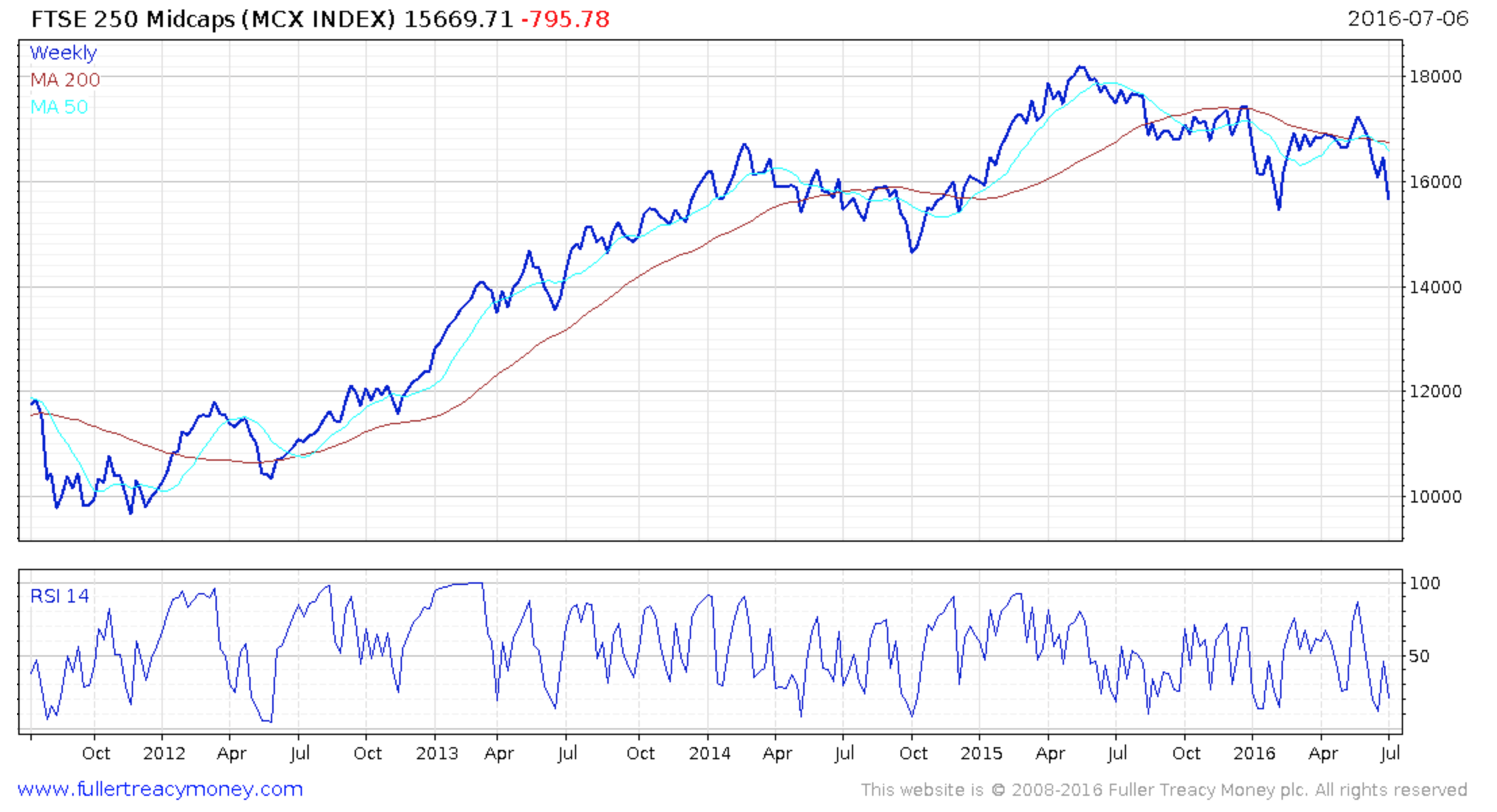
The contrasting fortunes of the FTSE-100 index (whose members derive 70% of revenues overseas and whose earnings are boosted by sterling’s decline) and the wider UK equity market (predominately opposed of domestic companies) has been marked since the referendum vote. Here are the Footsie and 250 indices over five years. The latter has fallen further in percentages terms than the former, which ironically, in the light of all the dire pre-vote warnings, is higher today than it was when the referendum campaign began, although still below its high around the end of Q1 2015. Both the FTSE 250 and most smaller cap indices had a long period of strength between 2012 and 2014. The recent setback needs to be seen in that longer term context.

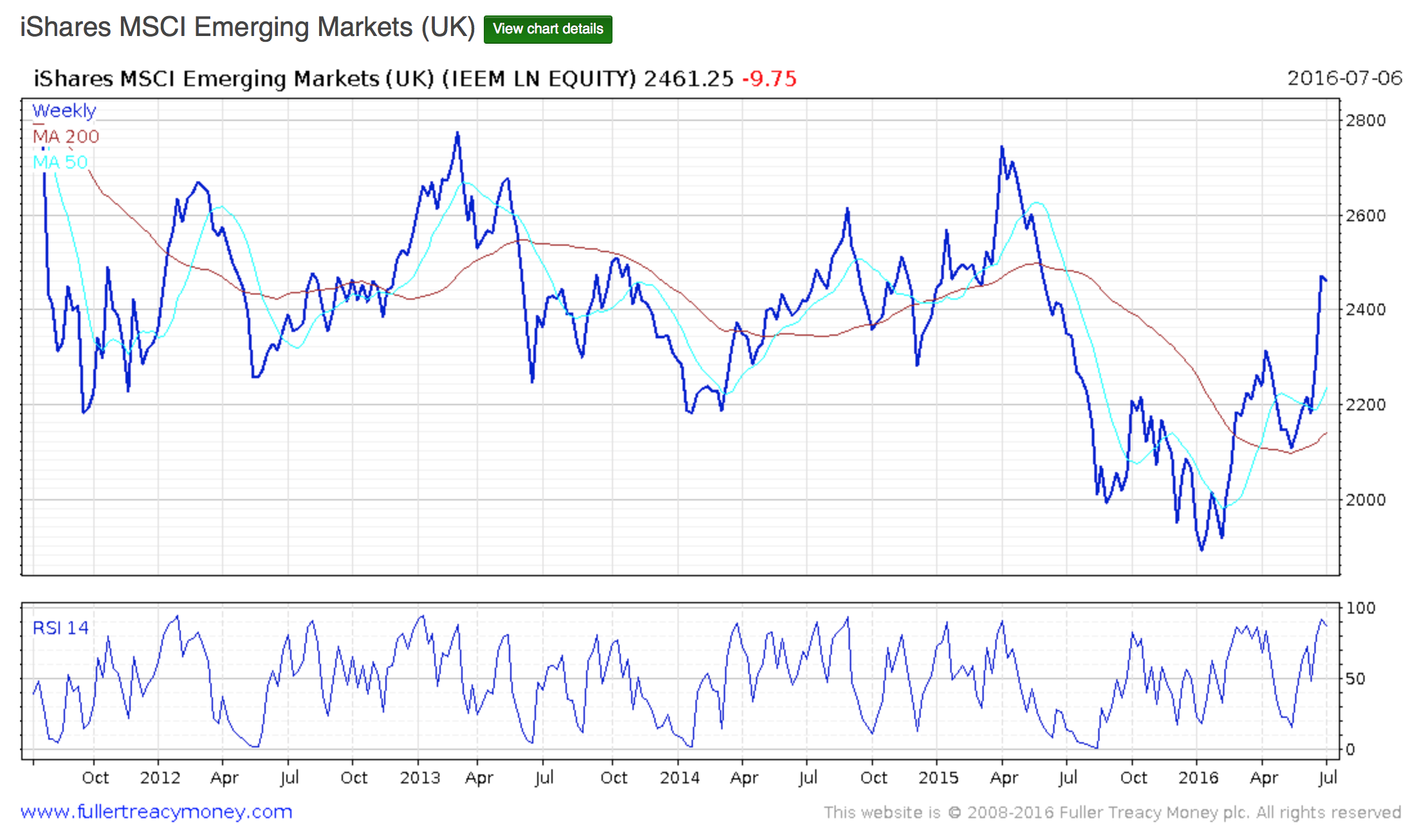
Looking further afield, the US equity market (S&P 500) has been trading sideways for some time, but until the Brexit vote was finally threatening to break out of its trading range to the upside. The economic data looks reasonable, despite one recent, possibly rogue, monthly jobless figure. Emerging markets, which have sold off sharply since 2012, have meanwhile recovered strongly, helped by the recovery in commodity prices and (for UK investors) the strength of sterling. I have added to my position in Murray International, the global investment trust, and one of the prime beneficiaries, more than once since the start of the year.


Volatility, although it spiked after the Brexit vote, has fallen back to a relatively low level, well below those seen during the global financial crisis in 200708 and the more recent eurozone crises.

Conclusion: almost all these charts, with the exception of the last, point to either short term oversold or overbought conditions, which is what typically happens when the markets react to a surprise event. It is reasonable to expect some retracement from here in both equity and bond markets, creating trading opportunities. Commodities and emerging markets look to be establishing significant rebounds, and are trading above their 200-day moving averages. However, given how many issues about Brexit remain to be resolved, the uncertainty is likely to put a brake on any sustained equity market recovery in the UK until the autumn. If as expected Theresa May wins the Tory leadership campaign, the risk of political instability and/or some form of constitutional crisis will be eliminated, at least for now.
Notebook: the yo-yo on rates continues
Friday’s poor jobless figures in the United States have thrown the markets another curveball. Just as investors had convinced themselves that a second interest rate increase was finally imminent, along comes the latest disappointing payrolls numbers to cast that expectation into doubt once more. What is more, it seems certain to rekindle fears that the US economy has run out of steam and may be heading for recession – an idea that was last being thrown around at the start of the year. Expect another wave of “told you so” bearishness.
Well, we will see how right that turns out to be. Analysis of the markets’ recent history of making interest rate calls only allows for one conclusion: that nobody has any real idea where interest rates are heading (and, to be honest, it is often like this). Market-implied interest rate expectations have been consistently way off, and move so rapidly from one day to the next as to have little practical value. The correct response to anyone who tells you they are extremely confident that interest rates will or will not rise a few months hence is simple: “stop kidding yourself. You have no idea”.
Having said that, there is no doubt that the Federal Reserve would love to be able to raise interest rates and continue the process of normalising the yield curve after so many years. We could all heave a sigh of relief if that were to happen, but there is no doubt either that normalisation still looks a long way off. Even though there are tentative signs of inflation returning in the US, UK and even Japan, it still remains everywhere below the central banks’ target rate of 2%.
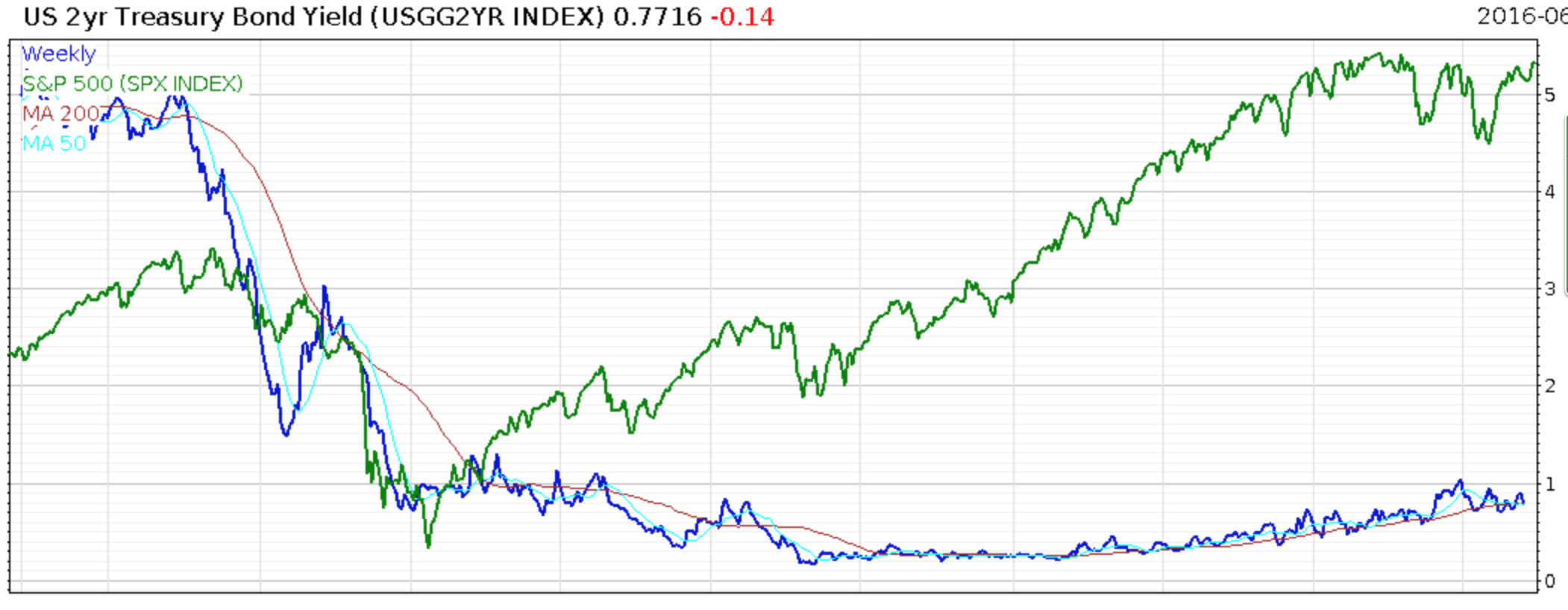
While the two-year Treasury yield has been edging up in snail-like fashion over the past four years, consistent with a slow but steady tightening of conditions, the yield curve (the structure of yields over time) has been stubbornly flattening. It is not yet inverted, which happens when long term yields fall below shorter term rates, a traditional warning sign of an imminent recession, but it is certainly not suggesting either that investors are expecting an imminent start to a positive interest rate cycle.
As far as the prospect of a recession goes, foolishly or otherwise I spend a lot of time looking at a range of indicators that attempt to highlight when a recession may be imminent. The jobless/employment figures are certainly not one: unemployment is a lagging variable, so its predictive power if very limited. A comprehensive survey of conditions provided by an organisation called Recession Alert, although far from perfect, summarises more than 50 different potential indicators and as yet provides no reason to panic, as the chart below suggests. Neither it nor other well-known publishers of leading indicators suggest that recession is imminent. But clearly nor does it paint an overly positive picture. Conclusion: real vigilance is needed.

There was not that much time on Friday for the markets to digest the implications of the poor jobless figures – there were knee-jerk reactions in gold and the dollar – so it will be interesting to see how they react over the course of the coming weeks. As far as portfolio positioning is concerned, in the current environment, my view is there is no option but to adopt the same stance as the Federal Reserve: watch the data carefully. This is no time to be making all-or-nothing bets.
Having taken on some more defensive ballast a year ago, but within an overall risk-tolerant portfolio, I am sitting pat for now. One positive factor to note however is that the often useful advisors’ bullish sentiment index in the States is currently recording a very low reading, often a contrarian short term signal to buy the market. The UK market in particular continues to look potentially attractive ahead of the Brexit referendum vote, with commodity prices stabilising and a lot of fear priced in.
For those of a more cautious frame of mind, Numis last week produced a useful summary of the generalist investment trusts which have performed best in up and down markets over the last nine years. The charts below show the average percentage rise or fall in NAVs in months when the market has risen and fallen. Although there are no great surprises in it, it is reassuring to see that the likes of Capital Gearing, Personal Assets and RIT, which all feature in the Money Makers core portfolios, are still doing the job that they set out to do. (Whether RIT’s characteristics will change if it succeeds in its surprising merger approach to Alliance Trust is an issue that we will be returning to shortly).

Notebook: Terry Smith, what next?
Terry Smith is not lacking in self-confidence, to put it mildly, but I think even he must be agreeably surprised by quite how successful his Fundsmith global equity fund has become. I am not talking about the performance of the fund, which has been exceptional, although not a surprise, given the inherent soundness of his investment philosophy. It is the weight of the money that he has been able to attract which is the real eye-opener.
Speaking to him last week after the AGM of his other investment management venture, the Fundsmith emerging markets investment trust, it seems that the main fund took in something like £400m in new flows last month alone. The fund now has £5.8 billion in assets, all the more remarkable since the Fundsmith fund has never found its way onto the buy list of the country’s largest fund broker, Hargreaves Lansdown, whose endorsement (or lack of it) can make or break the fortunes of lesser mortals in the fund business.
 Despite this lack of support, but no doubt reflecting his talent for PR, Terry’s fund regularly occupies one of the top five spots in the list of most popular funds on the HL platform. When he launched the fund in 2011 I remember him telling me that his ambition was centred on reaching £200m in assets so that he could cover his costs.
Now with his 1% management fee, the fund management business is probably earning around £50m in fee income a year on 29 times that initial target sum. the obvious question now is: how long can the performance of the fund continue to leave all competitors in the wake?
Since launch the fund has generated a compound annual rate of return of more than 17% per annum, an impressive figure in an era of low returns. The fund has trumped both the peer group (see the Trustnet chart below) and the MSCI World benchmark by a handsome margin. Of course the style of the fund, which focuses on established cash generative businesses with strong competitive advantages and high returns on capital has proved to be tailor-made for today’s yield-hungry but risk-averse market conditions, in which so-called “bond proxies” have flourished.

Many of his competitors are waiting eagerly for those unduly favourable conditions to change, which at some point they certainly will. The fund may well underperform for a while at that point. I can’t see the fund ever doing really badly for long however. Why? Simply because the method has once crucial advantage over most mainstream global equity funds. Just as Warren Buffett does, by focusing on businesses with sustainable high returns on capital, and holding them for longish periods, his method exploits the inherent short term bias of both fund managers and investors in general.
No matter how many times this short-termism phenomenon is documented (and it is as old as the hills), it is never likely to change. A systemic bias that overweights near-term and underweights long term growth is a persistent source of market inefficiency. So while there will inevitably be poor individual years for the Fundsmith fund, long term returns are likely to remain significantly above average as long as the strategy remains unchanged and it continues to be implemented as advertised. Can we quantify that? The rule of thumb that Terry himself uses to project long term future returns is to add the yield on a stock (or portfolio) and add the sustainable growth rate in that metric, whether you use dividend yield, earnings yield or free cash flow yield (his personal favourite).
Charlie Munger, Buffett’s long-standing sidekick, pointed out years ago that over the longer term the return on any stock (or portfolio) must approximate to the long term return on capital that the business is capable of generating, with the price that you pay for it at the outset a secondary factor (and one that becomes ever less important the longer your holding period). This is not a wild surmise, simply a mathematical necessity. The secret as an investor is to be patient enough to allow those returns to materialise, given the inevitable volatility that earnings-obsessed, broker-driven traders and fund managers will generate in the quoted share price at any point in time.
The hardest part for the fund manager – more acute than ever in an era of rapid technological change – is to find the businesses that do have business models which are genuinely sustainable over long periods of time. There aren’t that many, but the challenge is something that Terry and his colleague Julian Robins, who are both experienced stock analysts, have so far shown themselves capable of meeting. The Fundsmith Equity Fund currently trades on an earnings yield of 4.2% and has a portfolio whose trailing 12-month earnings are growing at 6.6% per annum. If that rate of growth can be sustained, it implies a long term compound rate of return of between 10% and 11% per annum – handsome enough in a low inflation world, to be sure, but a good way below the 17% per annum it has generated so far. (The free cash flow yield is currently 4.8%, and implies a broadly similar outcome, assuming say a 5% growth expectation).
Conclusion: at some point the rate of return generated by the fund is likely to fall back. Because the fund has a concentrated portfolio of 27 stocks, and a high active share, the setback may well be quite sharp at one point. But that is not necessarily a good reason to sell or reduce your holdings. Funds like Fundsmith and Lindsell Train’s, which follow a similar approach, are most valuable as core portfolio components, held through thick and thin. The real wonder, given the obvious merit of the approach, is that so few other UK fund managers to date have adopted a similar strategy in managing global equity funds.
Both he and Terry Smith have demonstrated that the method worked well for many years before the onset of today’s current exceptionally favourable market conditions. The absence of effective competition so far can only be explained by the lop-sided incentives of the fund management business, which gives more weight to minimising business risk than it does to maximising investment returns. With these honourable exceptions, the global equity sector is one of the least effective of all fund sectors as a result.
What then of the emerging market investment trust, Terry Smith’s second fund venture, which has made a disappointing start to life as a quoted entity? The Fundsmith Emerging Equities Trust, to give it its full name, is much smaller than the global equity fund, having raised £193 million at launch in 2013 and and issued an additional 0.8m shares subsequently, taking advantage of the premium to asset value which it has enjoyed for much of its time on the market.
With emerging markets close to all-time lows in terms of relative performance against developed market equities, the Net Asset Value of the trust remains 5% below the issue price. The investment strategy is the same as that of the sister fund, with the difference that the component holdings have to be companies which derive the clear majority of their revenues from developing countries. Taking the same metrics as those adopted above, the portfolio has an earnings yield of just 2.7% and recorded earnings growth of 16.6%, which points to an expected long term return of around 19% if those figures are maintained (more likely perhaps is that the former may rise and the former will moderate).

In my view this outlook is subject to more uncertainty than the one for the global equity fund. Many of the holdings in the investment trust have limited free floats; several are local subsidiaries of multinational companies; liquidity is often poor and there are specific country political risks. Governance standards in some cases may not be so good. All this means that the mechanism by which the underlying performance of the businesses translates, Munger-style, into commensurate share price returns is less clear-cut and less certain than with the well-established liquid holdings in the open-ended fund. Nevertheless emerging markets as a class are undoubtedly attractively priced at the moment and the performance of the investment trust, when sentiment towards developing economies eventually starts to turn, may well turn out to be excellent too.
Notebook: what I tagged this week
Every so often I highlight a number of articles, or pieces of data, that have caught my eye, being either sensible, profound or (just as valuable) challenging to consensus views.
Opportunities in investment trusts
Selling by a big insurance company has hit the share prices of a number of investment trusts, according to the sector’s #1 analyst, Charles Cade of Numis, potentially creating some bargain opportunities, such as Witan at a 7% discount): Pension fund sell-off hits investment trust shares
For more on this issue, see also this edition of Investment Trust Intelligence (you will need to self-certify as an investment professional to access the site): Witan Discount Opportunity
Are market valuations crazily high?
Fund manager Bruce Stout has an ultra-gloomy view of the world and the shortcomings of monetary policy, expressed in some detail in the latest Murray International annual report. (Disclosure: I have recently bought a few shares in Murray International, which have fallen to a discount after two years of poor performance. Despite a strong rebound this year, they are still yielding 5.5%).
Woodford Q&A
Neil Woodford’s held an online Q&A with his shareholders this week – part of his commitment to greater disclosure and better communication with shareholders. His most interesting comments, in my view, were those on oil companies (negative; the oil majors are obviously over-distributing at current prices), the poor short term performance of the Woodford Patient Capital investment trust (message: er, be patient…) and the likely (limited, in his view) impact of Donald Trump were he to become President (see quote of the week below): Neil Woodford Q&A
Buy-to-let a fading force?
Money Week editor Merryn Somerset Webb’s explains why in her view the sums behind buy-to-let as an investment are no longer attractive: Buy to let investing just became a very bad idea
Has the ECB shot its bolt?
“The question everyone wants answered”, according to M&G’s Stefan Isaacs, is whether the ECB has reached limits of monetary policy. His conclusion:
“The reality is that increased productivity and greater innovation is much needed to drive the Eurozone. Antiquated bankruptcy regimes need to be radically reformed, red tape needs to be removed and the banking system needs to own up to further loan losses that it has yet to provision for. These changes aren’t easily achieved, not least because they require the sort of short term pain that politicians rarely have long run incentives to deliver”.
Income investing may now be a trap
History suggests that investing for income at current levels is dangerous, says veteran Wall Street strategist Richard Bernstein. Dividend yields have been more attractive in 75% of the past 80 years, and too many investors are following the same trend – rarely a good idea: No one ever grew wealth being scared (pdf)
Look out for a rise in inflation
Don’t assume that the market is right about there being no rate rises this year, says Ambrose Evans-Pritchard in The Telegraph – some inflation warnings signs are becoming apparent. (I share some of these concerns – inflation when it comes always catches investors by surprise): US inflation rears its ugly head as global cycle nears danger zone
Skewed risks in equities
Jeffrey Grundlach, one of the highest profile bond fund managers in the United States, says the risk-reward ratio on risk assets (such as equities) is poor at the moment – in his view, no more than 2% upside and 20% downside. He doesn’t think there will be a US interest rate increase this year, although he also concedes there is no clear-cut indicator that suggest a recession is imminent. There are some interesting charts in the presentation this piece links to: Gundlach’s warning for risk assets
Gold has turned a corner
Find out why Charlie Morris, former asset allocation guru at HSBC, now working independently, thinks that the bear market in gold is over. His newsletter Atlas Pulse comes out monthly, and lays out what is happening in gold and crypto-currencies like bitcoin in a highly accessible way. His view: it is not yet a bull market in gold, but moving that way. Look out for his comprehensive table summarising the history of gold’s bull and bear markets: Atlas Pulse April 2016 (pdf)
Chart of the week
Nearly 20% of the world’s bonds, as measured by the JP Morgan Aggregate Bond Index, with an aggregate value of $7 trillion, are now offering negative yields – quite astonishing (and scary) numbers. The percentage has tripled in the last six months alone.

Quote of the week
“Donald Trump’s candidacy has clearly polarised opinion in the US. His popularity, in my view, is in part a product of the ongoing economic difficulties faced by many developed countries. Socio-economic groups that have not benefited from the recovery of the US economy since the financial crisis feel marginalised and are showing an increasing preference for ‘outsider’ politicians, like Bernie Sanders and Donald Trump. Trump’s more extreme political views on the campaign trail are likely to moderate significantly, if he were elected. In addition, the checks and balances in the US political system would clearly make some of his more extreme policy choices unlikely to prevail. My conclusion is, if he were elected, it would have a very limited impact on the US economy”.
Neil Woodford, founder of Woodford Investment Management
Attractive discounts in the investment trust arena
Here are the latest z-scores, as recorded by the broker Numis. A negative score indicates that the discount on an investment trust is wider than its historical average, and therefore a potentially attractive entry point, while a positive figure suggests the reverse. There may be reasons for these discount movements, which is why the lists are only described as “cheap” or “dear” in inverted commas. Always do further research before acting on these signals.

Image source: www.istockphoto.com
[printfriendly]
Notebook: banks, Buffett and more
Central bankers are losing their followers
Since the financial crisis market forecasts have consistently been wrong, almost invariably in the same direction, underestimating growth and over-estimating bond yields. But now financial conditions are tightening? Why? Because, says Gerard Minack, former Morgan Stanley pundit turned independent commentator, investors are losing faith in monetary policy and the power of central bankers to keep on pumping up asset prices. You can read his comments in full on the Woodford Funds blog. He doesn’t think that is going to change – a hugely important development for risk assets if he is right. It could mark a turning point in the post-crisis cycle.
The euro is still “extraordinarily dangerous”
Mervyn King (as was, now Lord King of Lothbury), the former Governor of the Bank of England, makes a similar point in his new book The End of Alchemy, which has been serialized in The Telegraph this week. Monetary policy alone cannot save us from another financial crisis, he says. He also highlights how “extraordinarily dangerous” the euro project has become. “Put bluntly” he concludes
“monetary union has created a conflict between a centralised elite on the one hand and the forces of democracy on the other. In the euro area, the countries in the periphery have nothing at all to offset austerity. They are simply being asked to cut total spending without any form of demand to compensate. I think that is a serious problem. I never imagined that we would ever again in an industrialised country have a depression deeper than the United States experienced in the 1930s and that’s what’s happened in Greece. It is appalling and it has happened almost as a deliberate act of policy which makes it even worse”.
When will Buffett go ex-growth?
This week has also seen the publication of Warren Buffett’s annual letter to shareholders, a regular must read for all investors. This year’s letter is shorter than usual on general observations about the craft of investing, but interesting on the reasons for long term optimism about the US economy (a familiar theme) and climate change (whether a real danger or not, “not a concern for investors”). The insurance business whose cash flow (or “float”) is the engine that has powered Berkshire Hathaway’s exceptional returns over the past 40 years gets another big write up. For an interpretation of what this means for shares in Berkshire Hathaway, you may find this (quite dense) commentary by a long term Buffett follower helpful. More interesting perhaps is his earlier post Berkshire Hathaway: The Next Ten Years, which assesses the probability that at some point not too far away the company will decide to start returning capital to shareholders in large quantities, just as Microsoft started to do about 20 years ago.
Who to blame for secular stagnation
Is “secular stagnation” a risk for the US economy, as Larry Summers, former US Treasury secretary, has argued? The historian Edward Chancellor assesses this issue in his latest column for Breaking Views. These concerns are nothing new, he notes.
“Unsurprisingly, the notion of secular stagnation was first mooted in the aftermath of the Roaring Twenties. The boom, wrote Alvin Hansen in 1934, comes about when industry is “artificially stimulated by an overdose of easy credit [which]…is the basic cause of the depression.” Hansen lamented that Americans in the early 1930s had shown a “degree of public nervousness and impatience which has necessitated wholesale experiments with forced methods of recovery.” Similar traits resurfaced in the wake of the last financial crisis. Secular stagnation is the unintended consequence of easy money policies, both before and after 2008. It’s only while those remain in place that Buffett’s breezy optimism about America’s economic future looks misplaced”.
In the eye of the storm
Jacob Rothschild (Lord Rothschild) is also worried, he tells investors in RIT Capital in its latest annual report, published this week. Here are a couple of extracts: “We became increasingly concerned about global equity markets during the last quarter of 2015, reducing our exposure to equities as the economic outlook darkened and many companies reported disappointing earnings. Meanwhile central banks’ policy makers became more pessimistic in their economic forecasts for, despite unprecedented monetary stimulus, growth remained anaemic. Not surprisingly, market conditions have deteriorated further. So much so that the wind is certainly not behind us; indeed we may well be in the eye of a storm. Our view is that 2016 is likely to turn out to be more difficult than the second half of 2015. Our policy will be towards a greater emphasis on seeking absolute returns. We will remain highly selective when considering public and private investment opportunities. Reflecting this policy, our quoted equity exposure has been reduced to 43% of net asset value with private investments at 26%”. (Note: RIT is a core holding in the Money Makers investment trust portfolio).
An investment trust think-in
J.P.Morgan Cazenove are the largest market-maker in investment trust shares and the go-to broker for institutional investors. I was at their annual investment trust conference, hosted by Christopher Smith, their investment trust analyst, ten days ago. The panel sessions on asset allocation, peer to peer lending (positive), emerging markets (to me, unconvincing, though the longer term arguments seem strong) and property (focus on income from here) were particularly interesting. Look out shortly for an interview on Money Makers with Sebastian Lyon, CEO of Troy Asset Management, and investment adviser to the Personal Assets investment trust, who was one of the speakers in the asset allocation debate.
The case for investing in junk
What about high yield bonds (otherwise known as junk bonds)? Yield spreads over government bonds have widened dramatically in the last year, and not just because of the falling oil price, which threatens to lead to widespread defaults among lenders to oil and energy companies. Does the crash in junk bond prices create an attractive entry point for portfolios? I have only just caught up with this note from Ben Inker of GMO, the US fund management group founded by one of my favourite investors, the grumpy Yorkshireman Jeremy Grantham four decades ago. Inker’s conclusion:
“At current spreads, high yield seems to be no worse than fair value and probably better than that, even if we assume (as we do) that we are entering a fourth default cycle. In today’s environment, that makes it one of the best available risk assets for investors. But the nature of the high yield market suggests it is a good candidate for overshooting fair value to the downside whenever defaults begin to rise in earnest”
GMO are building a position but (characteristically) Inker adds:
“It would be lovely to claim we will be able to time the bottom for credit precisely. We will not, and unlike with equities, even if we did know the timing perfectly, getting material exposure to the asset class quickly would be extremely difficult. This leaves us with the hunch we are probably getting in a little early, the fear that we might not get all the exposure we would like before spreads move to less attractive levels, and the sure knowledge we won’t get the bragging rights of having called the turn. In other words, it seems to be an utterly classic value investing opportunity”
How to monitor your wealth manager’s performance
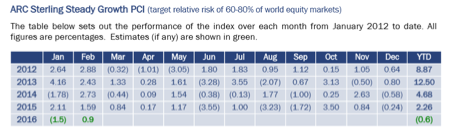
How well is your portfolio doing – or, more pertinently, how well is your adviser or wealth manager doing for you? The latest survey of wealth management performance by Asset Risk Consultants has just been released (go to www.suggestus.com for more detail). ARC lumps performance of the scores of wealth management firms whose performance they monitor into four main categories, depending on the degree of equity risk adopted. Here are the results for the steady growth bucket. As expected performance year to date has been muted – down in January, with some modest recovery in February. I will be providing regular updates on these figures as the months go by.
It is return on equity that counts, stupid
Another of my favourite fund managers, Terry Smith, was in good form at this annual shareholder meeting this week, naturally pleased (as am I) with the fund’s fifth consecutive year of outperformance and making a strong personal pitch for the merits of Brexit. It is worth revisiting his comments on the popular notion that so-called “bond proxies” – global companies that have stable earnings and strong business models – are overvalued. You can read them in the Fundsmith Equity Fund Annual letter (pdf). Note also his analysis of how the companies he owns in the fund would look if their results were reported as an ordinary listed company would do.
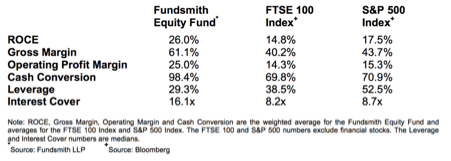
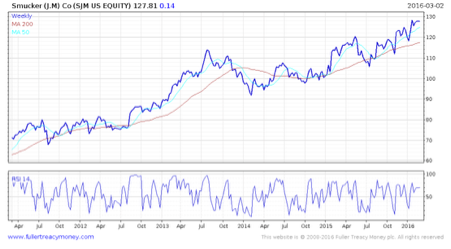
He also revealed this week the name of the two new companies in which Fundsmith has been building a position. These turn out to be IDEXX, a US veterinary diagnostics business, and the delightfully monikered J.M Smucker, another US consumer staples business. It makes peanut butter and jam, among other things. The company slogan is “With a name like Smucker’s, it has to be good”. In recent years its share price performance has been just that, but on conventional analysis the shares look expensive at 38 times earnings. It will be a good test of the Fundsmith thesis that quality always pays off in the end.