In the latest Money Makers podcast, our series of in-depth conversations with leading professional investors, Jonathan Davis talks to experienced stockpicker Paul Mumford, who has been running what is now the £150m Cavendish Opportunities Fund, a small and midcap specialist, since 1988. He is also the author of a recently published book, The Stock Picker, which look backs entertainingly over the highs and lows of his 50-year career in the financial markets and explains why he is not too worried (yet) about Brexit, higher interest rates or Jeremy Corbyn becoming Prime Minister. He also discusses some of his favourite investment themes at present.
Revisiting AIM after a year of shocks
In the latest Money Makers podcast we catch up again with Chris Hutchinson, lead fund manager at Unicorn Asset Management, the boutique small cap and AIM fund management firm that boasts one of the best long term records in its universe. How has the fund coped with the fallout from Brexit and Trump’s election? What are the prospects for future returns? And why despite strong demand has the firm capped new applications to its market-leading AIM venture capital trust at just 10% of assets?
Notebook; lessons of the Leave vote
Yorkshire’s finest export
Yorkshire folk did not think much of immigration, if the Brexit vote result is to be believed. That is not the view however of one of the most successful British exports of recent times, a crusty Yorkshireman who went to America but never migrated back, and to our loss has since built a hugely successful fund management business in the United States from scratch. Jeremy Grantham co-founded Grantham Mayo Otterburn back in 1977, having earlier spent a short time working for Batterymarch, an innovative investment business in Boston, Massachusetts. Grantham Mayo, or GMO for short, now looks after more than $100 billion of other people’s money (yes, $100bn, you read that right). That is not bad going for a guy who, he once told me, started his working life as a “bedpan salesman” for his father’s medical supplies business in Doncaster.
Batterymarch’s founder Dean le Baron was a colourful and visionary figure who was one of the first to try and harness computer power in the management of investors’ portfolios, as well as pioneering the case for emerging markets. Although Grantham’s own firm has not followed LeBaron down the index fund path, he remains a fearless advocate of the need to use mathematical tools when managing money. His particular hobby horse is the concept of mean reversion, the idea that while all financial markets swing from periods of boom to bust and back again, valuations – whether measured as price earnings ratios, book values or other metrics – all eventually revert to their average level over time. But he also acknowledges that this can take years to happen and that in the meantime, momentum investing – the idea that you keep on buying those sectors or styles of investment that have done well recently – will go on producing good results for longer than anyone thinks possible. In the end, though, all such momentum trades blow up. Blow up was what happened with tech stocks back in 2000 and financials in 2007, and both outcomes were ones that Grantham had warned about, albeit well before they actually happened.
In his latest must read quarterly letter, in which like all good Yorkshiremen he dispenses trenchant advice, in the manner of a Geoff Boycott or Fred Trueman, Grantham attributes both the rise of Donald Trump and the outcome of the Brexit vote to a lack of social cohesion, the growing disparity between the minority of “have a lots” and the majority of “have littles” in society. This populist backlash has been widely commented on, but Grantham characteristically has a chart to show that it has been most visible in countries where the disparity between the richest and the average citizen has become most marked. The US and the UK are high up the list that list. If that correlation holds, watch out for more political trouble next in in Greece and Portugal and (more surprisingly) Australia and New Zealand.
 As for the equity markets, he remains of the view that they are overvalued on mean reversion grounds, but they probably won’t come down to earth for a while, such is the force of the monetary measures (QE, cheap money and so on) that are being used to keep them in the stratosphere. “Despite brutal and widespread asset overpricing” he says “there are still no signs of an equity bubble about to break, indeed cash reserves and other signs of bearishness are weirdly high”. All the great market declines of modern times, he points out, when the stock market fell at least 50% – 1972, 2000, and 2007 – were preceded by “great optimism as well as high prices. We can have an ordinary bear market of 10% or 20% but a serious decline still seems unlikely in my opinion”. In other words, the message is: stay calm for now, but be prepared for trouble ahead. There is still too much gloom around to call this yet a huge market top.
A cautionary tale
A prominent hedge fund investor at one of the best known firms in London was at school with George Osborne and has been close friends with the former Chancellor ever since. Two days before the referendum he called Mr Osborne to enquire how the campaign was going. The reply he got: “We are very confident of getting a decent majority”. There was no reason to doubt his word. It would have been the easiest thing in the world for Osborne to say something less clear-cut, if that had been how the leaders of the Remain campaign saw it. As it was a private conversation with a friend of more than 30 years standing, this was not a case of “he would say that, wouldn’t he?” We know from many other sources that Osborne and Cameron were indeed highly confident of having won the vote. That confidence was shared by the financial markets and, it seemed, the bookmakers.
The moral: to be a successful investor, you need good information and good contacts. But when it comes to judging what the great British public is thinking, even the best information and the best contacts count for nothing. You might as well go down to the pub. Listen to what is being said there and you are likely to do just as well as the richest hedge fund manager. Thousands did just that, it seems. Although the weight of the money at the bookies was heavily weighted towards Remain, the number of individual bets on Brexit outnumbered those for Remain by a comfortable margin. The people not only spoke, but backed their vote with hard cash, just as hedge fund managers are supposed to do, albeit on a somewhat grander scale.
Impressive but meaningless
The analysts at FE Trustnet had the bright idea last week of looking to see which fund managers had outperformed the market both in the run-up to the referendum and in the month that followed. Needless to say there weren’t that many who managed both. Few fund managers had actively positioned their portfolios for Brexit and many have since been forced into hasty readjustments once the No vote came through. According to the Wall Street Journal, the dispersion in performance between stocks that have done well since the vote (such as utilities, drug companies and consumer staples) and those that have done poorly (such as banks, retailers, house-builders) has been the most extreme we have seen since the great financial crisis – the worst possible scenario for active fund managers.
Since most actively managed funds are also biased towards the midcap and small cap sectors, their poor performance relative to the Footsie index of larger companies makes it a racing certainty that most actively managed funds will have had one of their worst months for quite a while. (They had a decent run for a year or so before that however). Fully 14 of the 32 funds that did pass the FE Trustnet test (out of more than 230 in the UK All Companies sector) were index-tracking funds. By definition, although they can fall, tracker funds can’t underperform during a shock event, such as the Brexit result turned out to be. They also benefit from being more diversified than the average actively managed fund.
Credit therefore to Hugh Yarrow of Evenlode Income who topped the list of funds that did well both before and after the Brexit vote. He is a rising star that many fund analysts already speak highly of and this result clearly won’t do him any harm. Among the better known funds Newton Income and Jupiter Income (both under relatively recently appointed new managers, however) came out particularly well. That doesn’t alter the fact that a single month’s performance, even a dramatic one like the one we have just seen, is worse than useless when it comes to assessing whether a fund manager has genuine skill or has merely been lucky. Fund managers need to have worked through one and preferably two full market cycles (which means a career of at least ten years) before that kind of judgment can be made with anything resembling statistical confidence
Notebook: taking stock post Brexit
This is one of my regular round ups on the state of the markets, this time following the Brexit vote, but keeping an eye primarily on the medium to longer term context. It is easy to get sidetracked by the excitement of a new event into losing sight of the important longer term trends. Get the right side of the longer term trends and you can survive any number of short term shocks and setbacks. There is also some value in looking to spot opportunities created by excessive moves.
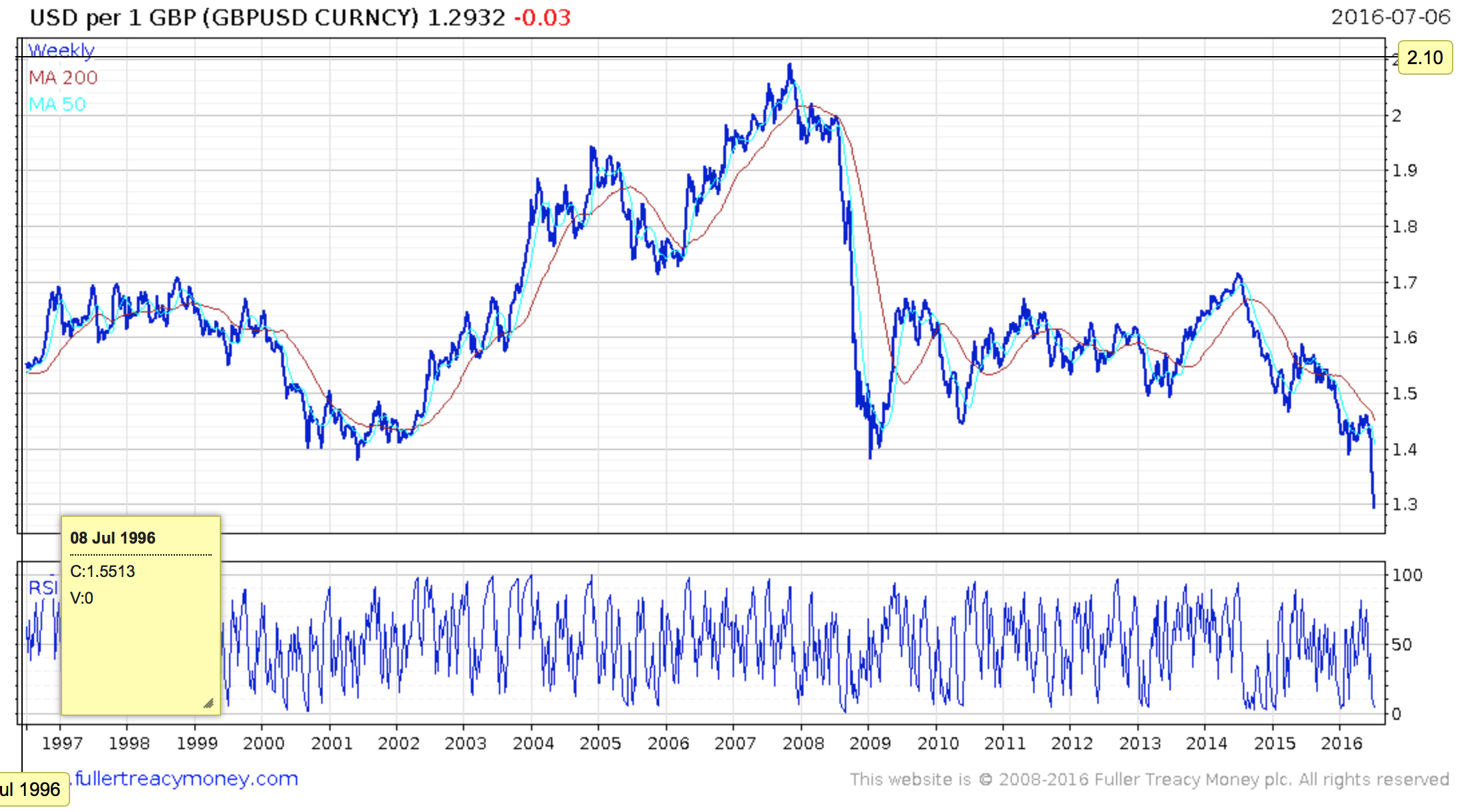
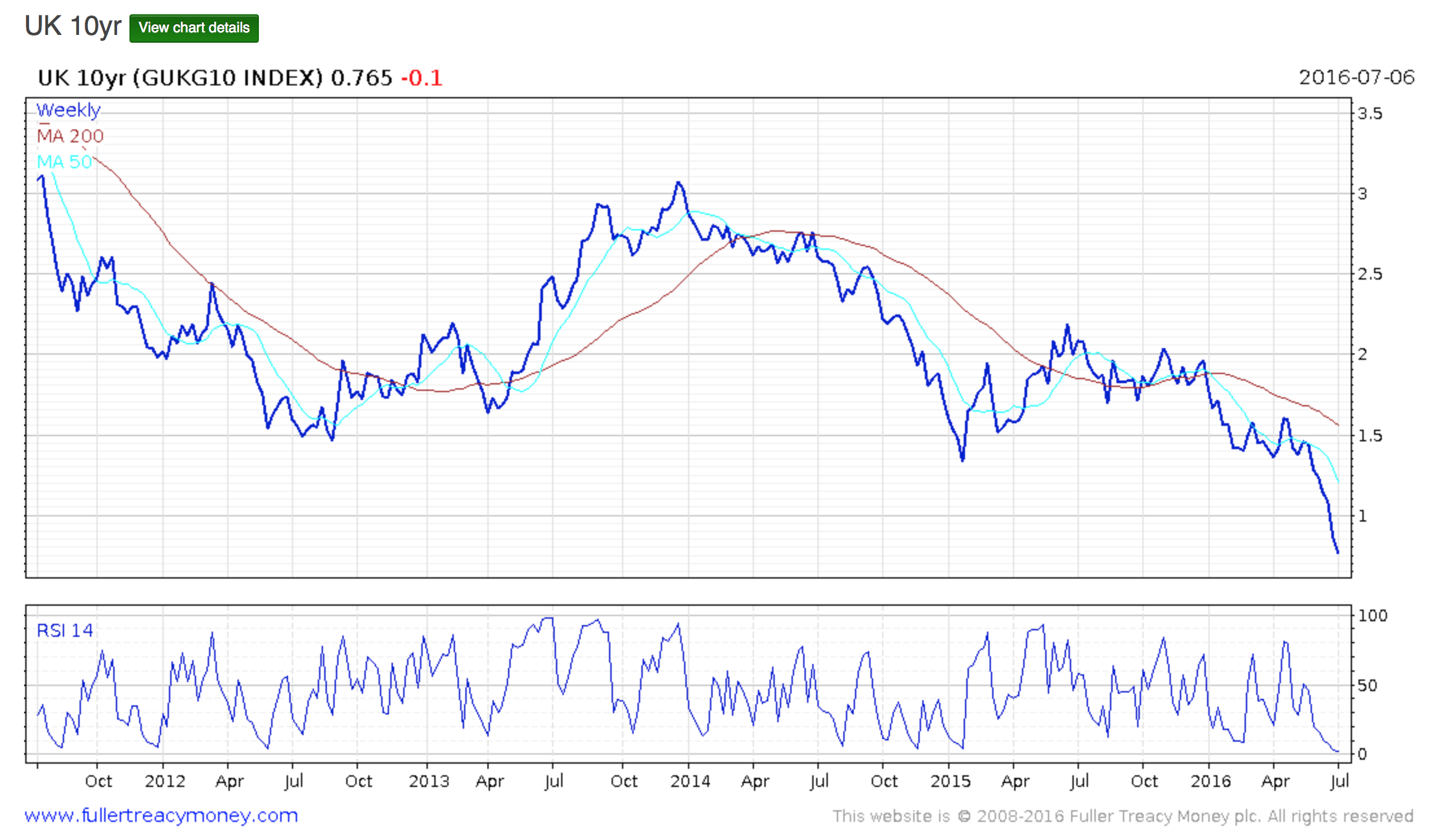
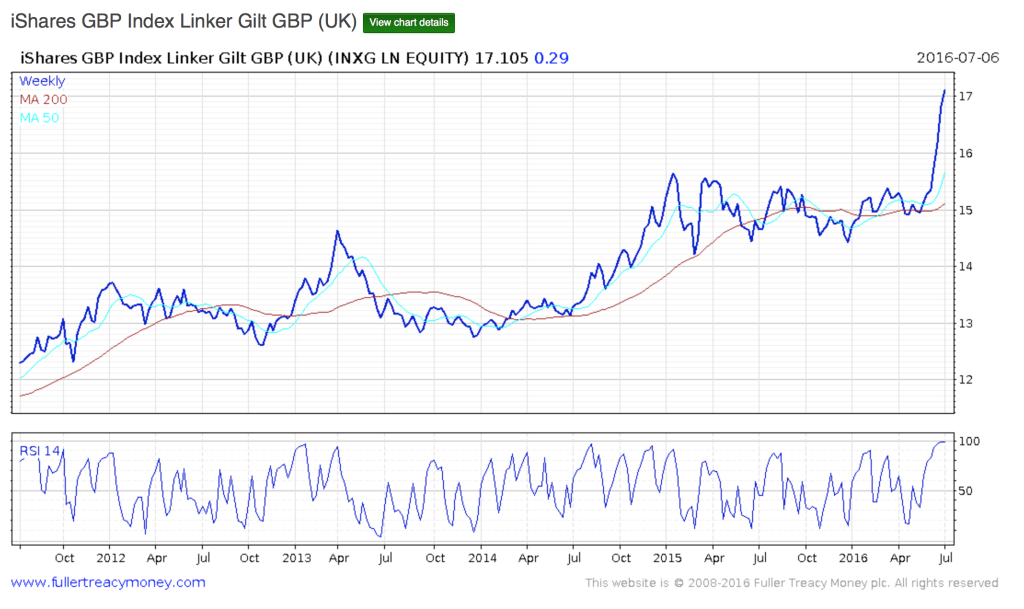
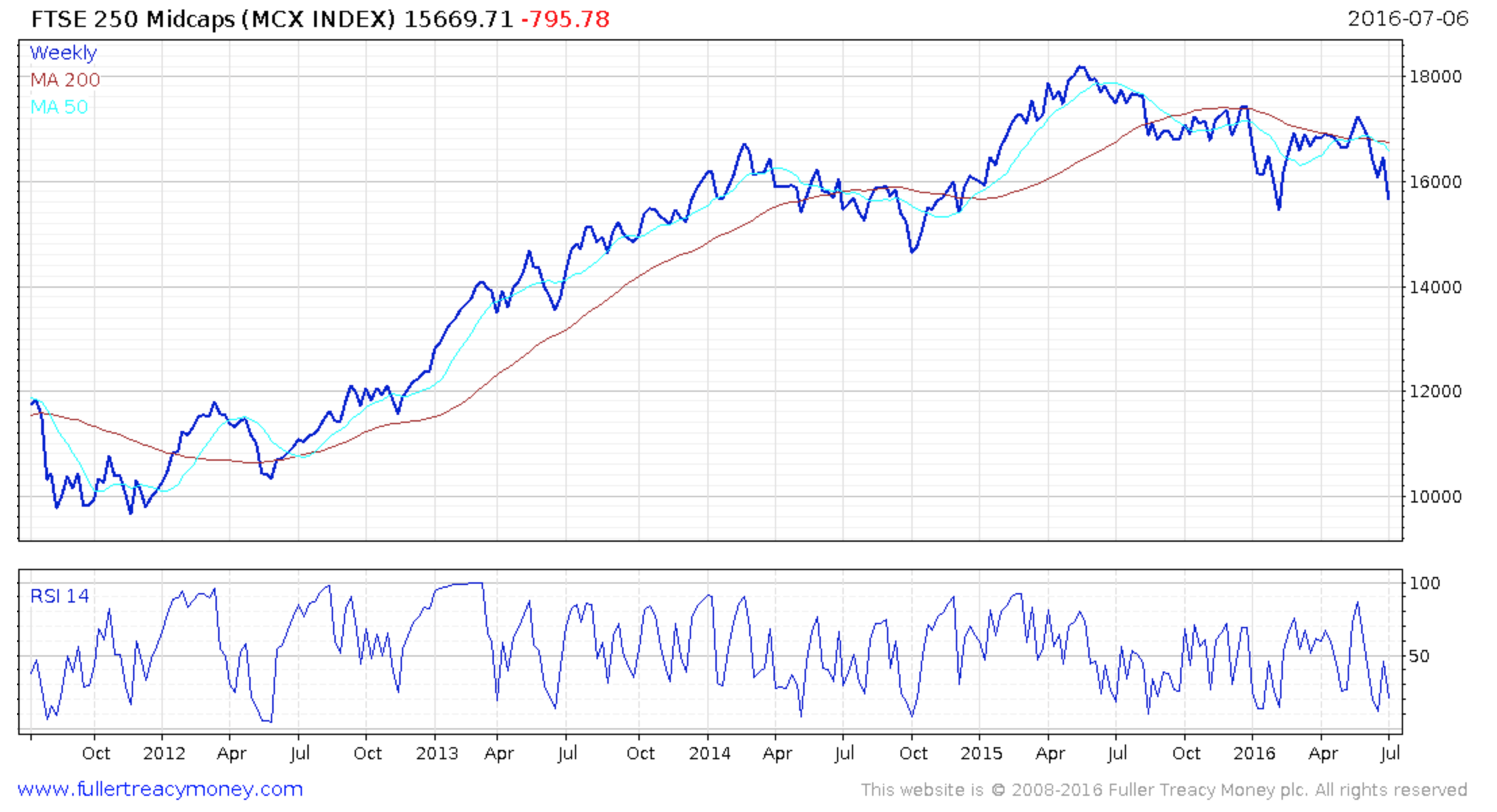
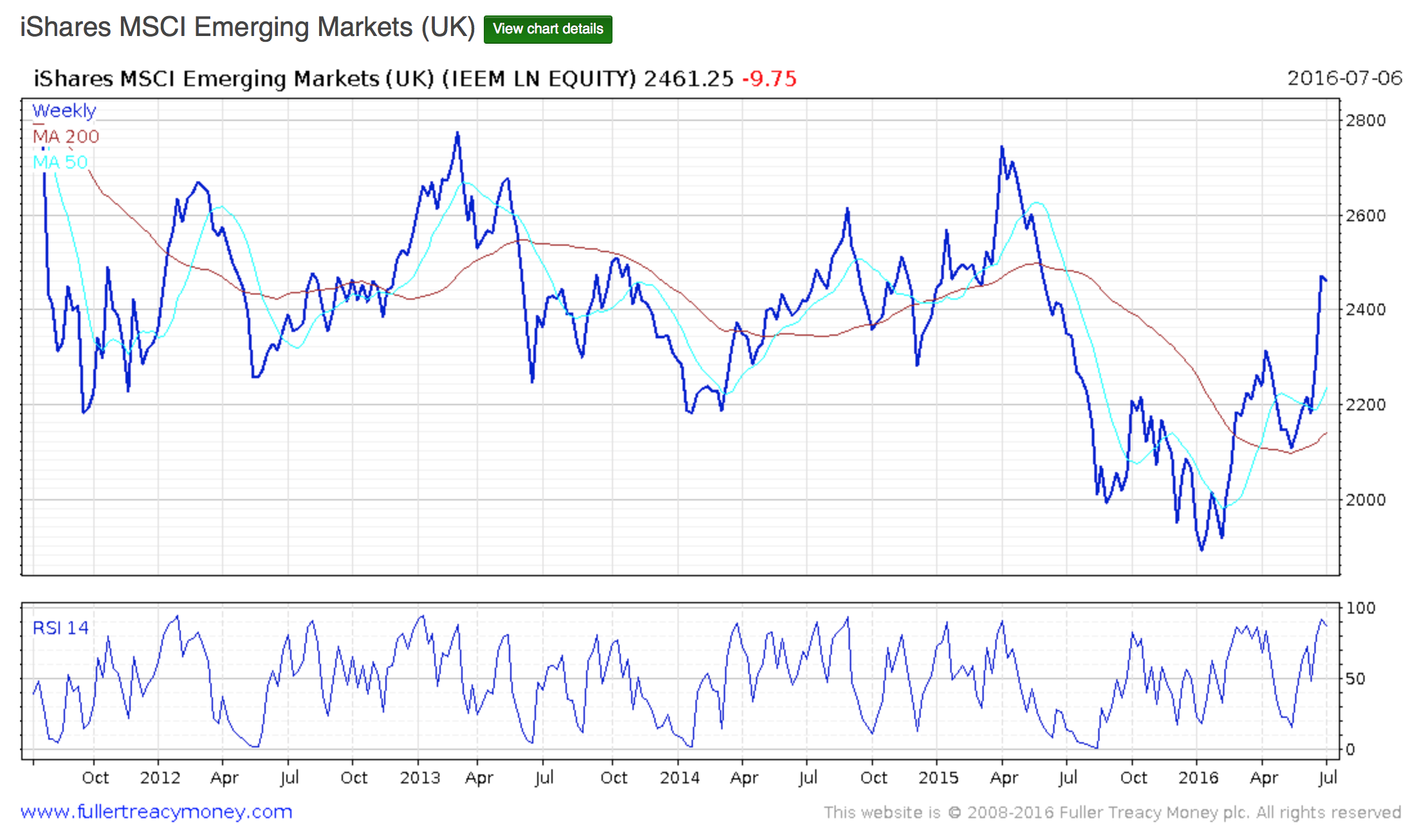
The charts are from Fuller Treacy Money and reproduced with thanks. They are correct as at midday on 7th July 2016. The lighter line on the main panel in each chart represents the 200-day moving average. The RSI at the bottom of each panel represents a standard 14 day momentum measure (overbought above 70, oversold below 30, in broad terms). Further notes will look at some of the more dramatic individual stock and sector moves and the behaviour of some model portfolios.
Sterling‘s decline has been the most obvious impact of the Brexit vote. Against the dollar, it has fallen to its lowest level since the 1980s, at the height of the miners’ strike. It is down 40% since its pre-crisis peak in 2007. Short term it now looks oversold, but it is impossible to rule out further declines, at least until there is some clarity on how and when negotiations for Brexit are likely to begin. But note that sterling has been in decline for more than two years, long before Brexit.
Bond yields have fallen together right along the yield curve. I show here both the 10-year and the 30-year yields on conventional gilts. Both are trading at all-time lows, though also appearing oversold on a short term basis. The yield curve remains upward sloping for now. An inverted yield curve, when longer term yields are lower than short term one, is a traditional warning of impending recession, but we are yet to see that materialise.
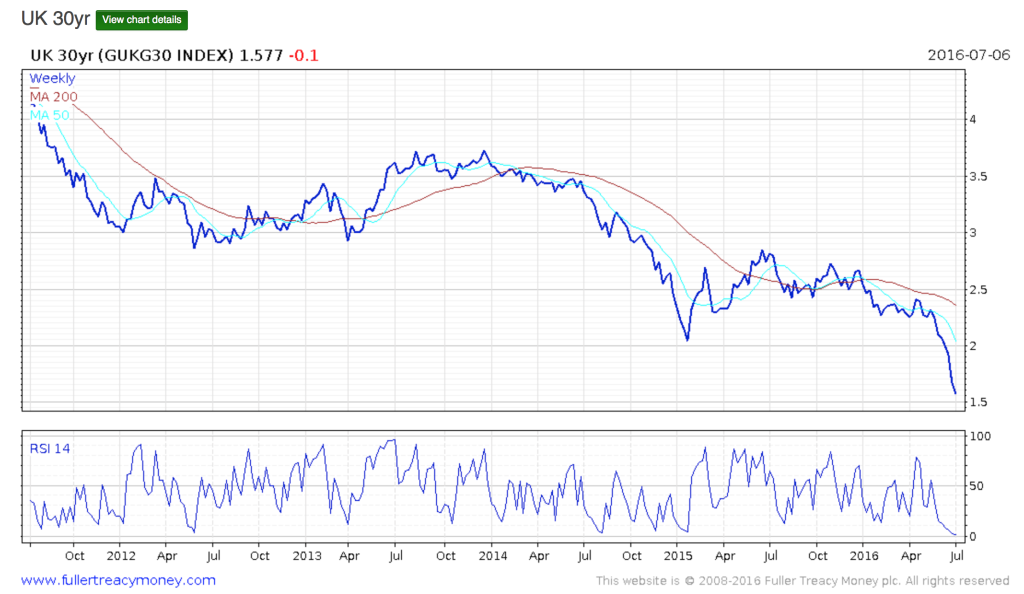
The fall in yields has produced some remarkable increases in gilt prices, particularly at the longer end of the curve (which is inherent in the structure of the market when yields are already ultra-low). It is important to remember that yields have been falling all round the world, with at least three countries (the latest being Switzerland) now able to sell 50-year bonds at negative interest rates – an unheard of phenomenon. There is no better indication of the fact that the world is trapped for now in a low growth, low interest rate, deflationary environment.

It is not just conventional index-linked gilts that have done well. Index-linked bonds, a core component in the Money Makers model portfolios, have also performed well. With inflation still at very low levels, real (inflation-adjusted) yields have also declined – another global phenomenon. That in turn has helped the price of gold, which normally does well when real yields are falling and is also benefiting from its traditional safe haven status. As geared plays on the price of precious metals, mining shares have more than doubled from their lows.

The contrasting fortunes of the FTSE-100 index (whose members derive 70% of revenues overseas and whose earnings are boosted by sterling’s decline) and the wider UK equity market (predominately opposed of domestic companies) has been marked since the referendum vote. Here are the Footsie and 250 indices over five years. The latter has fallen further in percentages terms than the former, which ironically, in the light of all the dire pre-vote warnings, is higher today than it was when the referendum campaign began, although still below its high around the end of Q1 2015. Both the FTSE 250 and most smaller cap indices had a long period of strength between 2012 and 2014. The recent setback needs to be seen in that longer term context.

Looking further afield, the US equity market (S&P 500) has been trading sideways for some time, but until the Brexit vote was finally threatening to break out of its trading range to the upside. The economic data looks reasonable, despite one recent, possibly rogue, monthly jobless figure. Emerging markets, which have sold off sharply since 2012, have meanwhile recovered strongly, helped by the recovery in commodity prices and (for UK investors) the strength of sterling. I have added to my position in Murray International, the global investment trust, and one of the prime beneficiaries, more than once since the start of the year.


Volatility, although it spiked after the Brexit vote, has fallen back to a relatively low level, well below those seen during the global financial crisis in 200708 and the more recent eurozone crises.

Conclusion: almost all these charts, with the exception of the last, point to either short term oversold or overbought conditions, which is what typically happens when the markets react to a surprise event. It is reasonable to expect some retracement from here in both equity and bond markets, creating trading opportunities. Commodities and emerging markets look to be establishing significant rebounds, and are trading above their 200-day moving averages. However, given how many issues about Brexit remain to be resolved, the uncertainty is likely to put a brake on any sustained equity market recovery in the UK until the autumn. If as expected Theresa May wins the Tory leadership campaign, the risk of political instability and/or some form of constitutional crisis will be eliminated, at least for now.
Notebook: D-Day minus one
Should you act ahead of the referendum?
Outlining one of five heuristics (or rules of thumb) that he says govern his approach to investment at a Kepler Partners investment trust conference last week, Nick Train of Lindsell Train offered this trenchant advice: “Every five minutes you spend on the investment implications of the referendum is five minutes wasted”.
This is eminently sensible for a long-term investor. Why? Because the referendum is a one off event whose precise outcome, it has become clear, cannot be predicted with confidence in advance; and nor – even more importantly – can we be certain about the consequences of whatever vote materialises.
There are simply too many imponderables. Only if you believe the direst warnings of the Remain camp about the consequences of a vote for Brexit (I don’t), and only if you believe such an outcome is a real possibility (which it is), is there a case for making changes to your investment portfolio. But even then it is worth pondering Nick’s general question: “Even if you know with absolute certainty what is going to happen, can you really be sure how the markets are going to react?”.
The important question is not what you think might happen, but where what you think sits in relation to what the market has already discounted. Against that you, as with all insurance, you have to set the cost of making changes that turn out not to make much difference. While this kind of decision can be make or break for professional traders and fund managers whose livelihood is determined by their fund’s relative performance, historical experience does not suggest that genuine long term investors gain much by such an exercise. If your largest holdings are companies like Unilever (which they are in Nick’s case), the logic for owning them is not going to be affected in any material way by the referendum vote.
What does seem likely is that sterling will take a further hit in the immediate aftermath of a vote for Brexit, and by implication will rally if there is a decisive vote in favour of Remain. That will be taken as evidence of a loss of confidence in the prospects for the UK economy. But as on past occasions, such as our exit from the ERM in 1992, the weakness of sterling will in turn act as a self-correcting mechanism that works in the opposite direction. The ability of the exchange rate to act as a pressure valve is precisely why the UK has performed better than most members of the eurozone, trapped as they are in a single dysfunctional currency zone.
Opportunities also created
Binary events like the referendum are however positive for investors in one sense, in that the surrounding volatility can create opportunities to buy shares or funds you already know you want to own at attractive prices (a different issue from betting on the outcome of the referendum itself). One such case that I have acted on is Alex Darwall’s investment trust Jupiter European Opportunities (JEO), which has had a period of relative poor performance and, for this and reasons of wider market nervousness ahead of the referendum vote, has drifted out to a 6-7% discount, despite normally trading at a premium.
The trust ticks nearly all the boxes a long term investor can want – a simple investment strategy, indifference to index performance, relatively low turnover and a talented and committed manager who has a substantial proportion of his personal wealth invested in his funds. As often happens, the investment trust Darwall runs has outperformed its sister open-ended fund by a significant margin (245% versus 196% over ten years to the end of May 2016), and this despite charging a performance fee. Although Money Makers does not give investment advice (how can it, not knowing who you are or any details of your personal circumstances?), I merely report that for me the opportunity last week to top up my SIPP holding of JEO at 486p and 502p seemed too good to miss.

Tracking the result
How to prepare for the results of the referendum vote itself? Open Europe, the independent think tank, has published a helpful guide for night owls and political junkies on how the count is likely to go. You can read it here. Unlike in a general election, there will be no exit poll on Thursday evening, leaving pollsters and pundits with several hours to speculate and chew over how the vote has gone.
While the first result (most likely from Sunderland) will come in pretty soon after the polling booths close at 10pm, it won’t be until 3am or 4am that the tea leaves will start to become clearer. The outcome should be known with fair certainty by 5am. One interesting point noted by Open Europe is that most of the regions that are expected to favour Leave will have their results come in relatively early, which suggests two things. One is that unless Leave have built up a significant lead by say 4.30am, there is probably no chance of them emerging as the winners. The second is that even if Remain do hold on to win, and the margin is relatively narrow, there is likely to be a point in the middle of the night when the results to that point are suggesting that the opposite outcome is ahead.
In other words, it could be a roller-coaster ride for supporters on both sides, unless their brains are already calibrated to make the necessary adjustments for social and economic status, political alignment and all the other factors that make a straight read through from the polls so difficult. Tracking the bookmakers’ odds through the night should provide a clearer picture, I suspect, as they will to some extent incorporate those necessary adjustments.